nishaniyaan

A visual ethnography of labor, illusion and the afterlife of objects · Amar Colony, Delhi · DDL 7007 Research Methods for Design
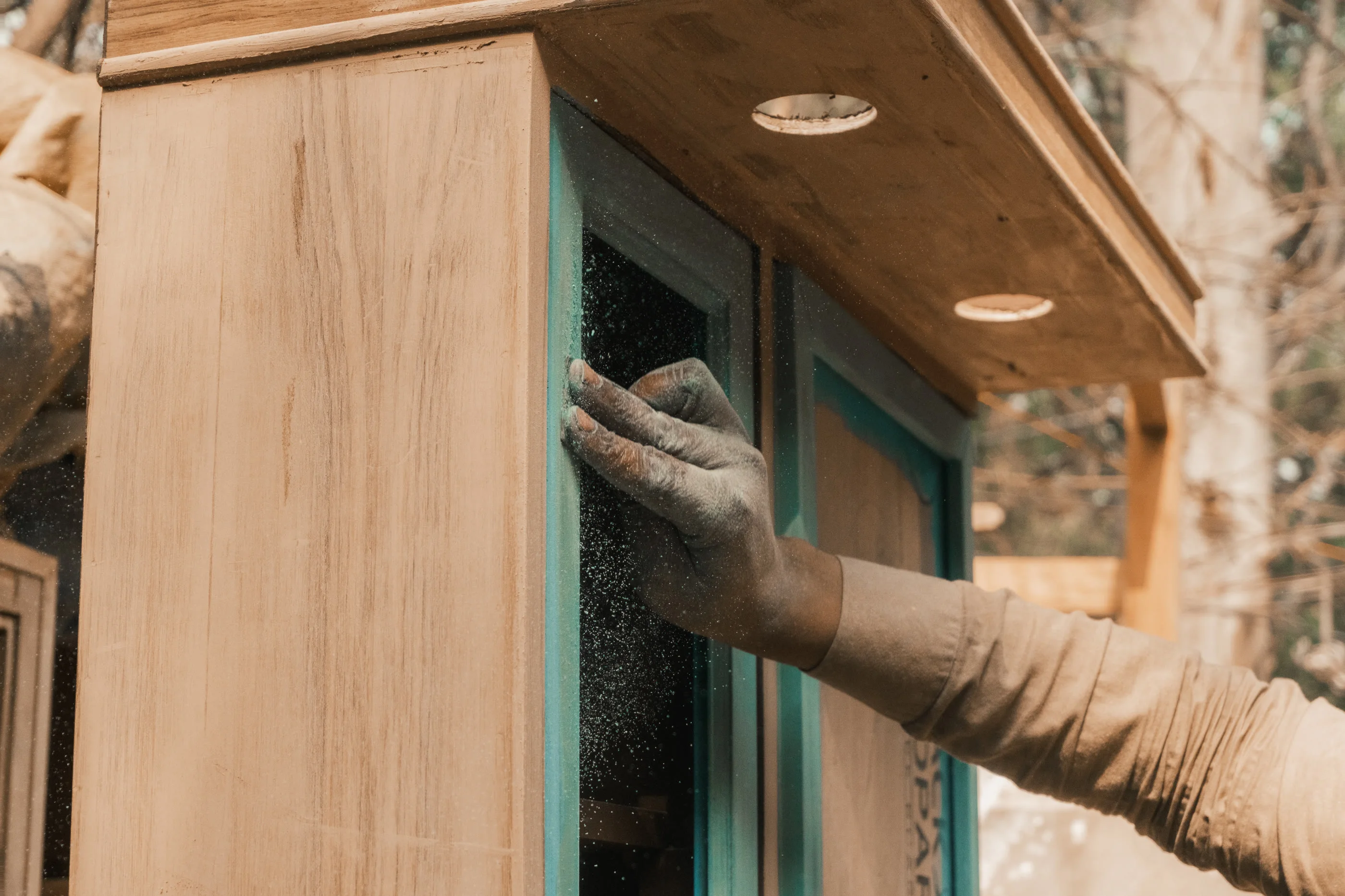
A dust-covered hand resting on a stripped wooden cabinet in the market

Tucked into the narrow lanes of South Delhi, the Furniture Market at Amar Colony appears without announcement.

Discipline
Visual ethnography and design research
Method
Covert observation, overt interviews, photo documentation
Place
Amar Colony Furniture Market, South Delhi
Context
DDL 7007, Research Methods for Design, IIT Delhi

With no marked boundaries and no clear moment of arrival, the market is known for its refurbished furniture pieces that spill into the street, quietly demanding attention.

What initially appears as an ordinary market gradually reveals itself as an assemblage of artifacts, spaces and lives layered over time. This project explores the market as a living ecosystem that survives within the fabric of modern Delhi.

Locating the market

It sits behind Lajpat Nagar, a thin spine of stores threaded between a gurudwara, a DDA park and the back alleys of the colony — entered from either end, never quite bounded.
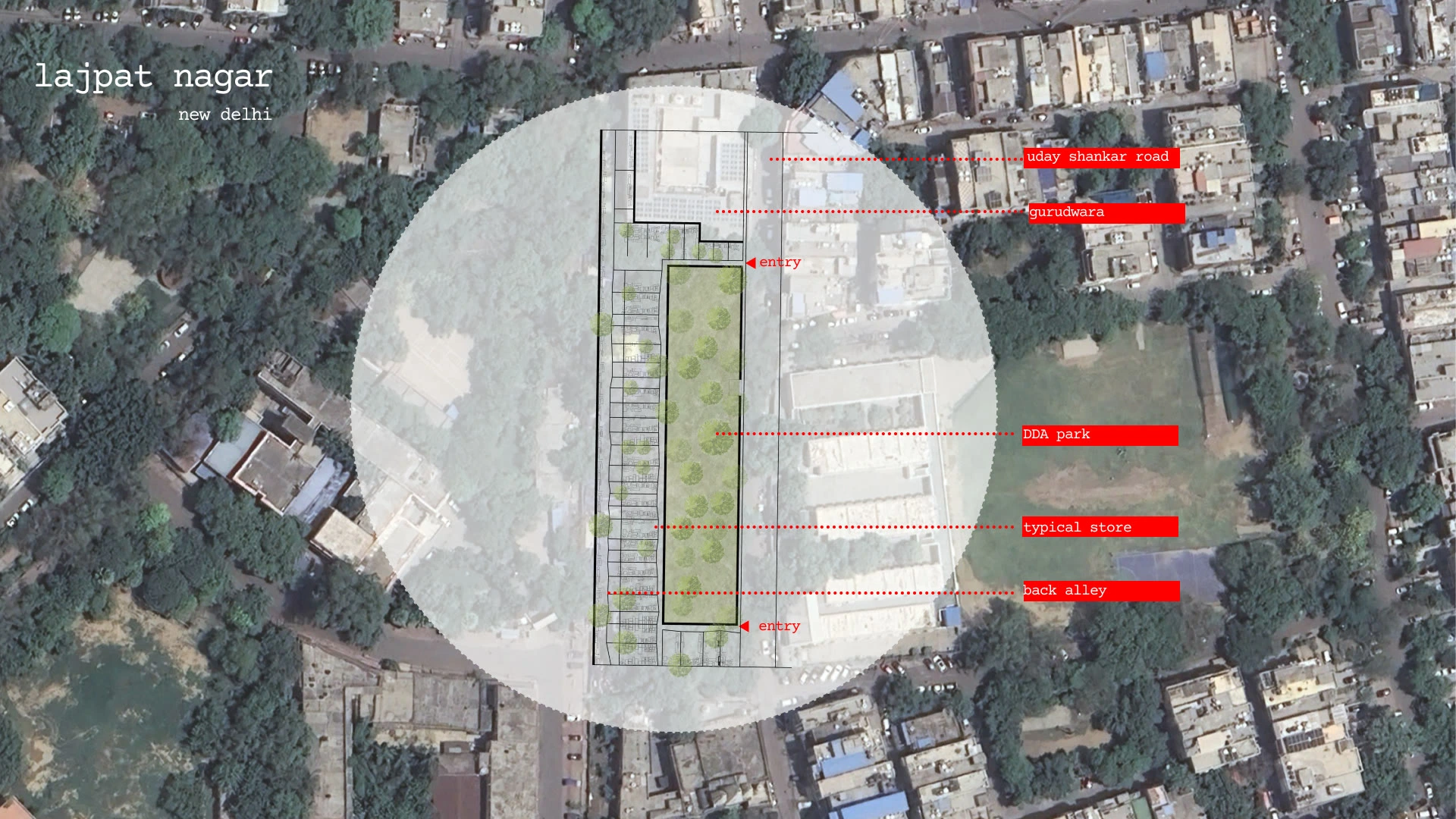
An annotated satellite map locating the market between Uday Shankar Road, a gurudwara, a DDA park and the back alleys
The market mapped from above, between Uday Shankar Road and the back alley.

The study employed a semi-structured ethnographic approach, combining covert observations with overt interviews to capture both visible practices and underlying narratives. Key stakeholders including shopkeepers, carpenters and customers were identified — interviews undertaken only after verbal consent, with participants informed of the documentation.

The Sneaky Photographer

The Silent Observer

The Explicit Communicator

How does the Furniture Market at Amar Colony function as a cohesive, living ecosystem despite, or perhaps of its informal organization?

A market built from displacement
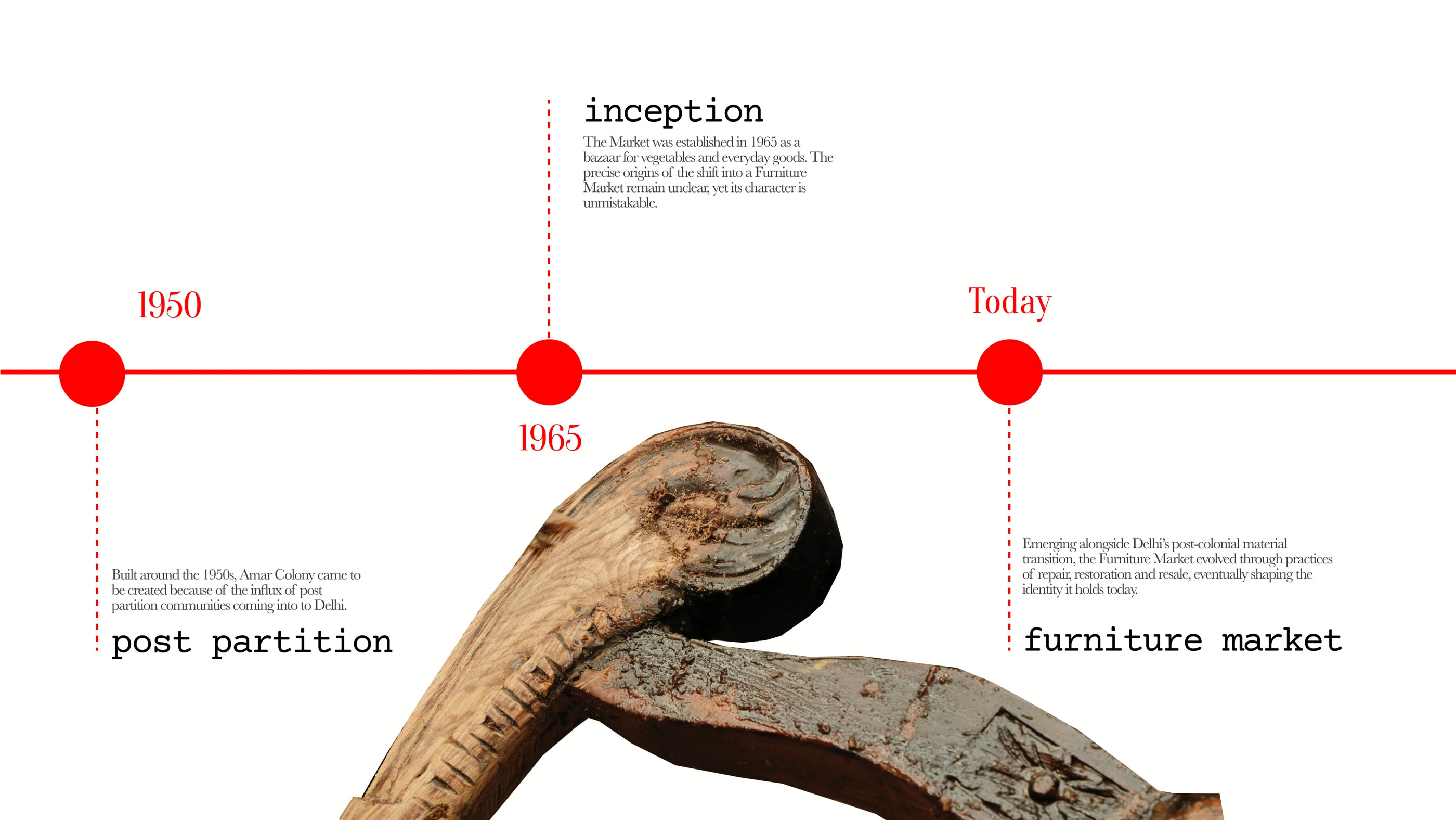
A timeline of the market — built around the 1950s by post-partition communities, established as a bazaar in 1965, and grown into today's furniture market
nishaniyaan

(markers of the past)

amidst the noise of trade, they carry stories longing for homes to return to

The market trades in four grades of object — from genuine heritage pieces to new furniture built to wear the appearance of age. Each carries its own claim to the past.
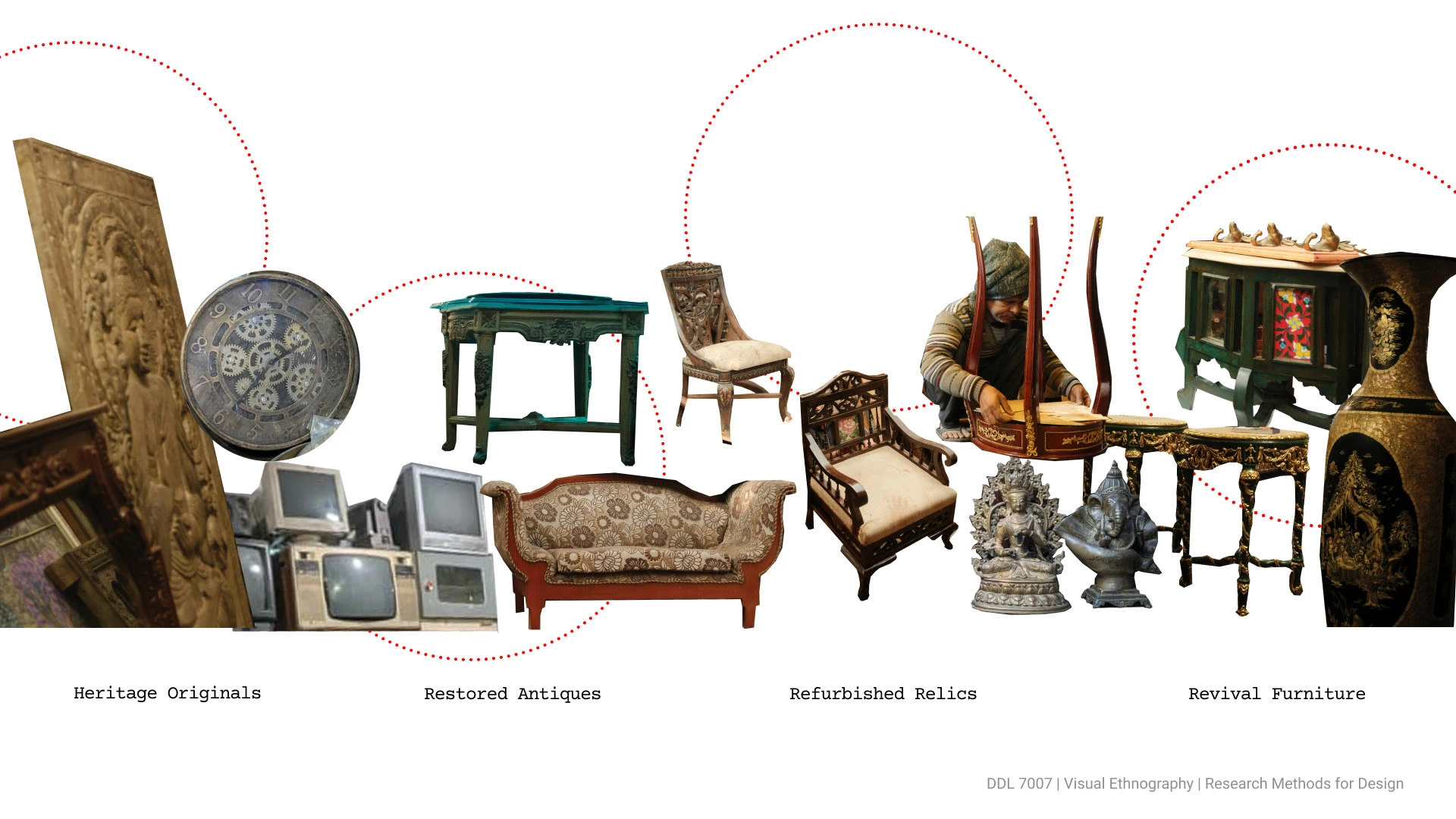
Four grades of furniture — Heritage Originals, Restored Antiques, Refurbished Relics and Revival Furniture — connected by red arcs
Heritage Originals · Restored Antiques · Refurbished Relics · Revival Furniture.
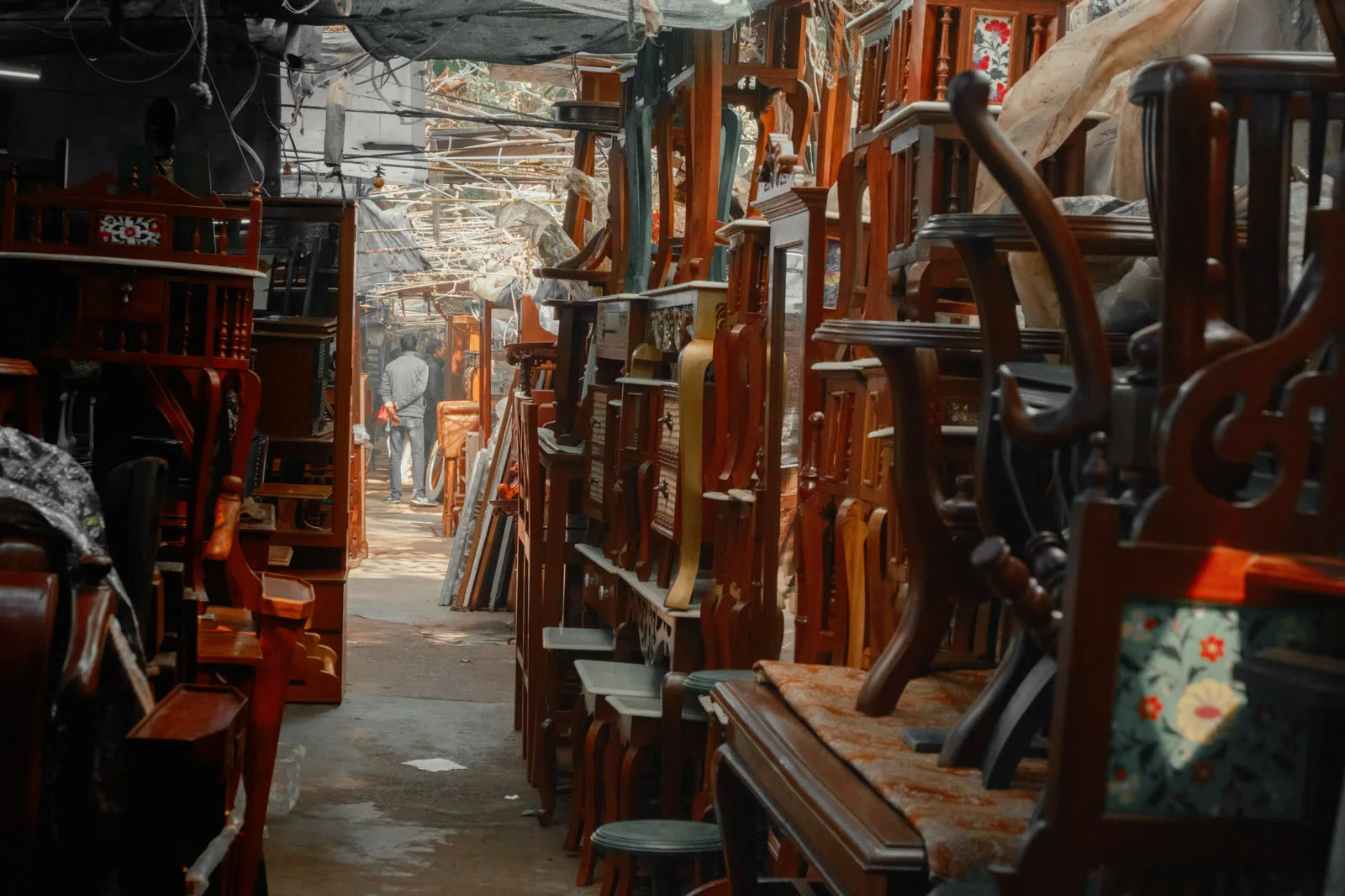
An aisle of furniture stacked into interlocked vertical towers
Furniture is stacked vertically, allowing the market to grow vertically. These interlocked towers are not random accumulations but a learned skill that maximizes stability and prevents collapse.
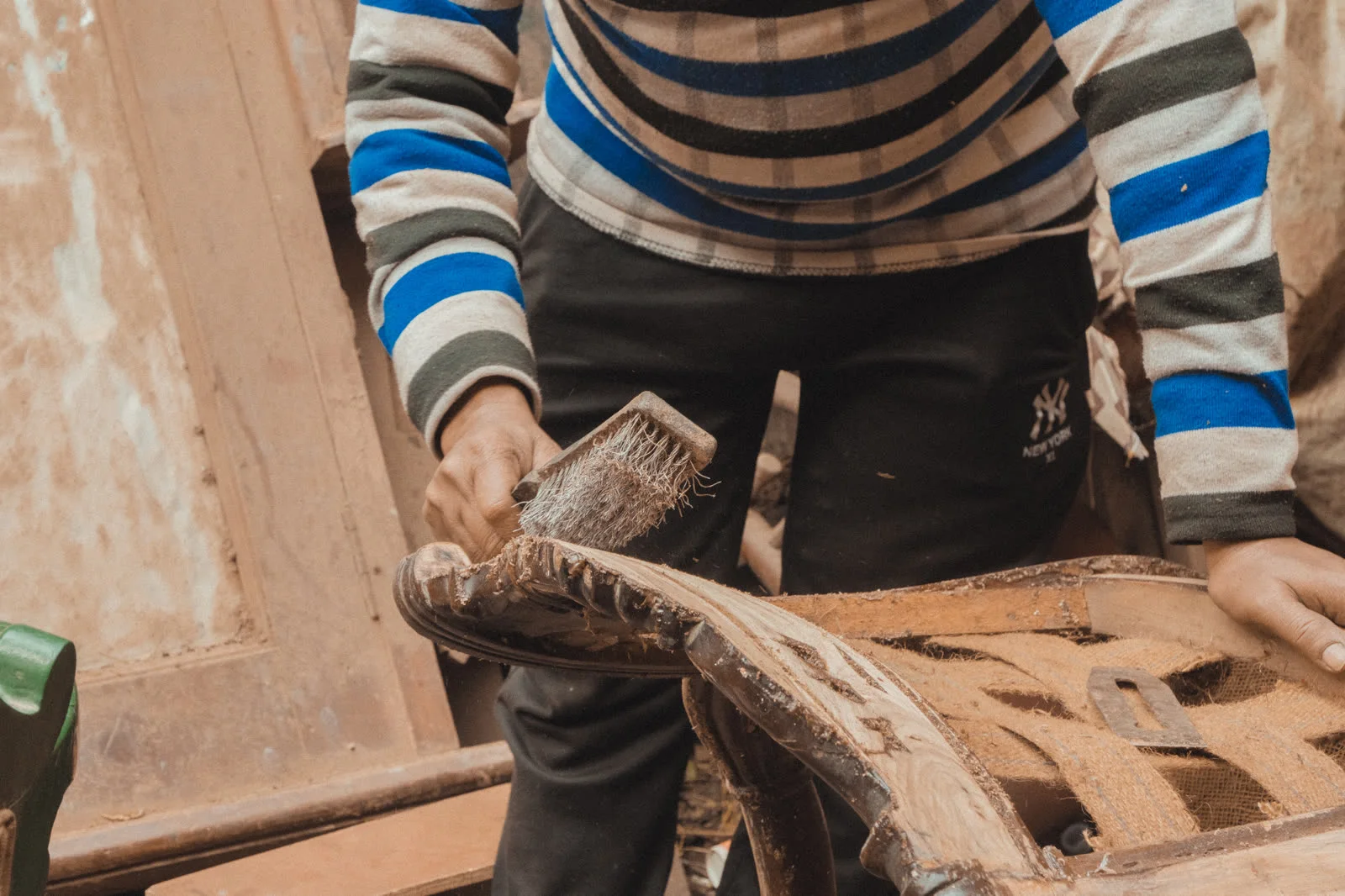
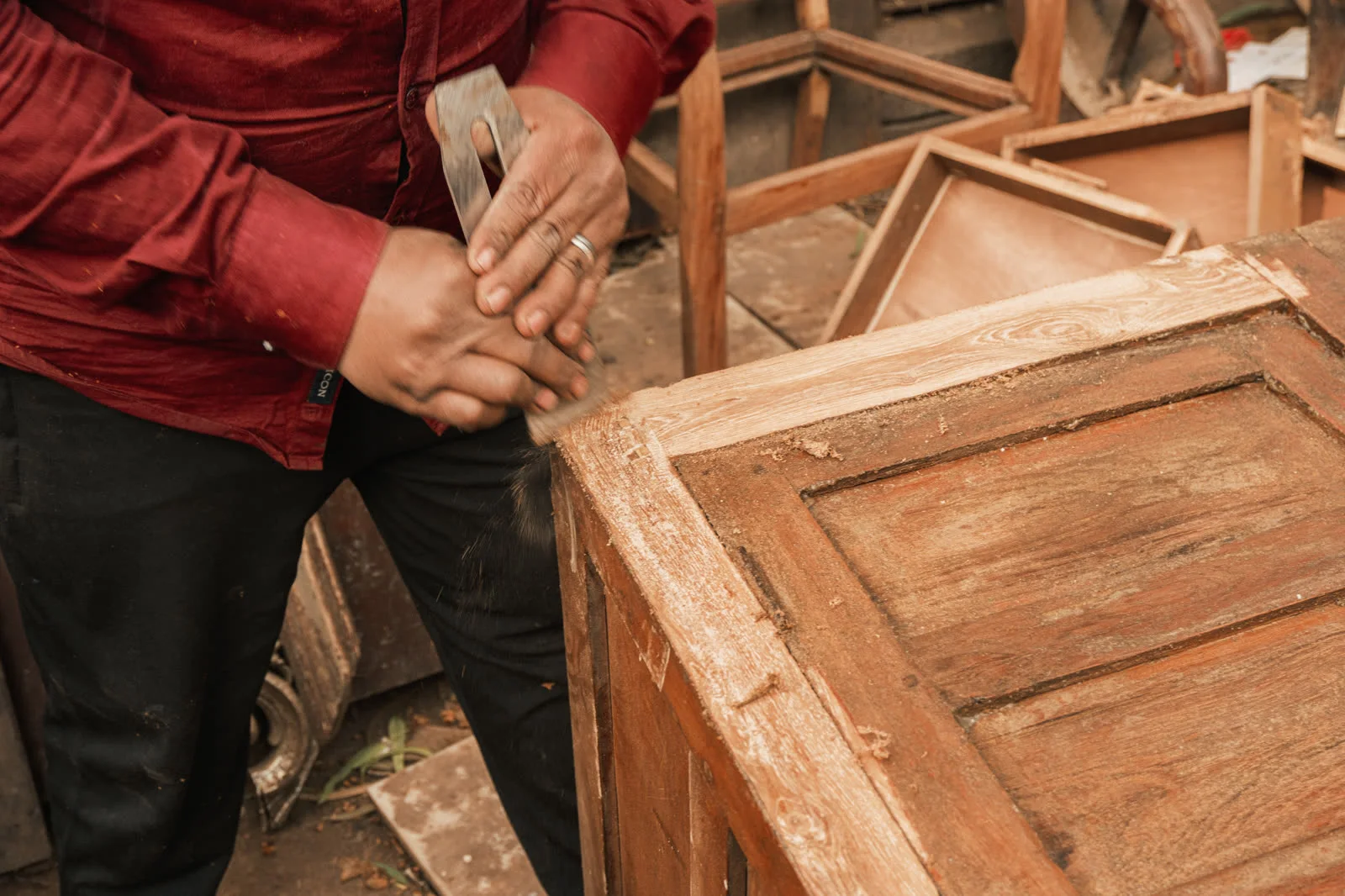
A worker scraping sagwan teak with a makeshift wire brush to mimic age
Some furniture is deliberately made to appear antique, with the sagwan teak scraped using makeshift tools to mimic age and wear. They enter the market as carriers of imagined histories.
A Burma teak closet of the kind sellers claim came from an embassy
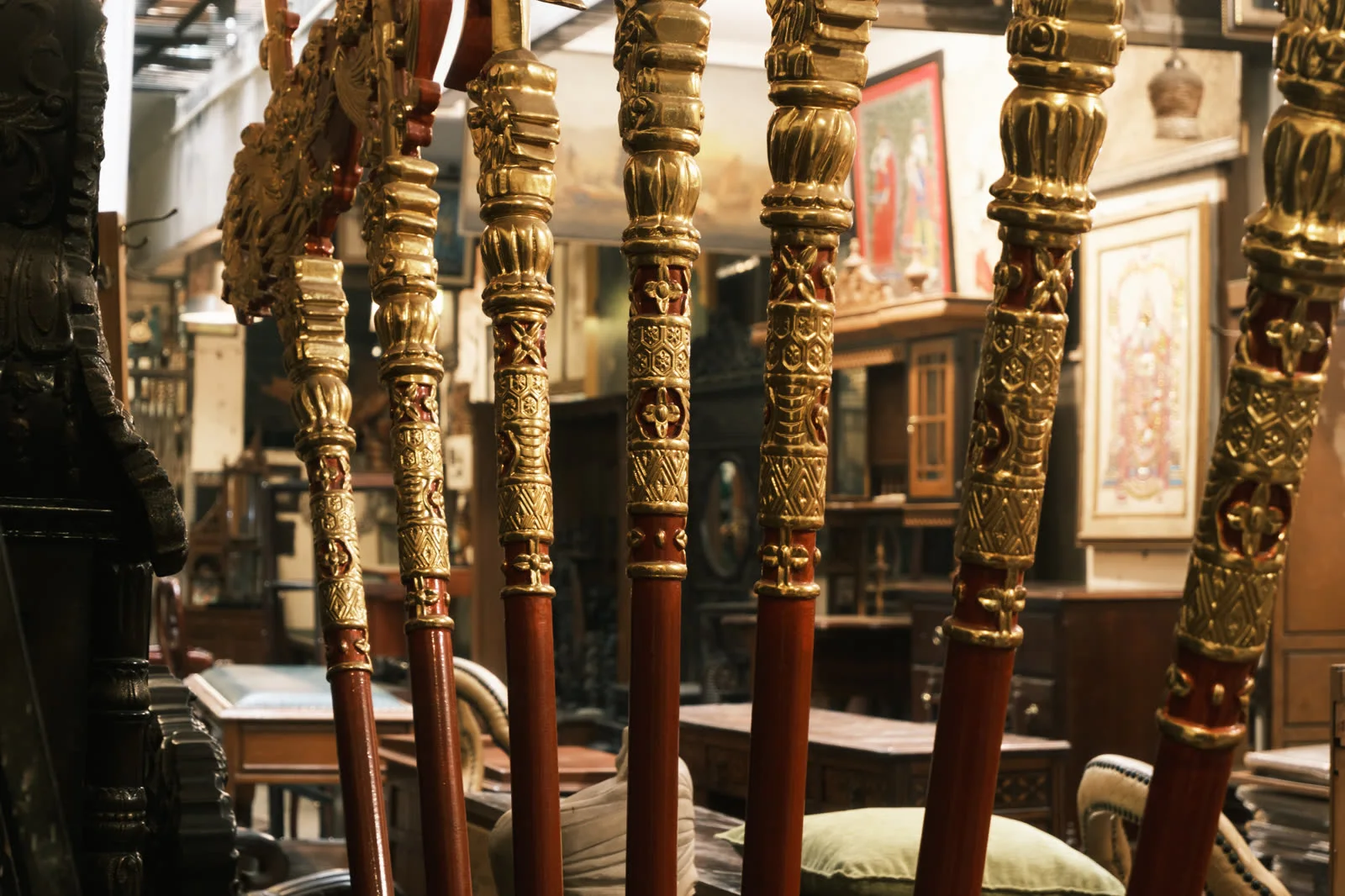
Be it the '50s Burma teak closet, a 70 year old Rajasthani four poster bed, Bombay art deco style sofas or vintage telephone sets, the market does not disappoint. Sellers often claim items are from "Embassies" to inflate value.

Unlike auction-house pieces that can be traced to a documented origin, antiques here have no verifiable history. Their defects turn each purchase into a calculated gamble.

Prices are not fixed or displayed. They emerge through the shopkeeper's reading of the buyer rather than through tags on furniture.
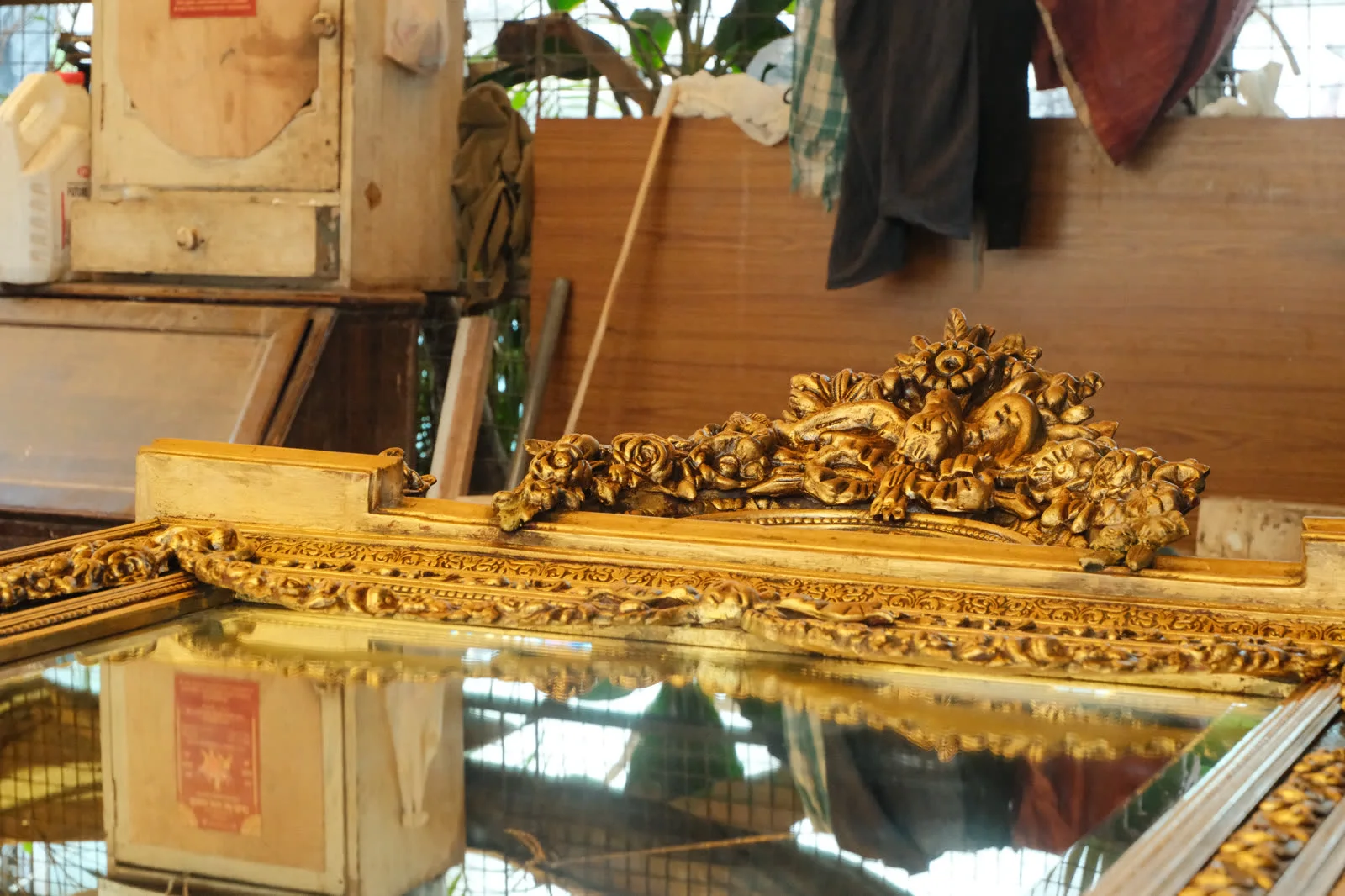
A weathered antique whose origins cannot be verified

The furniture market actively tracks shifting design trends and buyer preferences. This allows the market to remain responsive and commercially relevant.
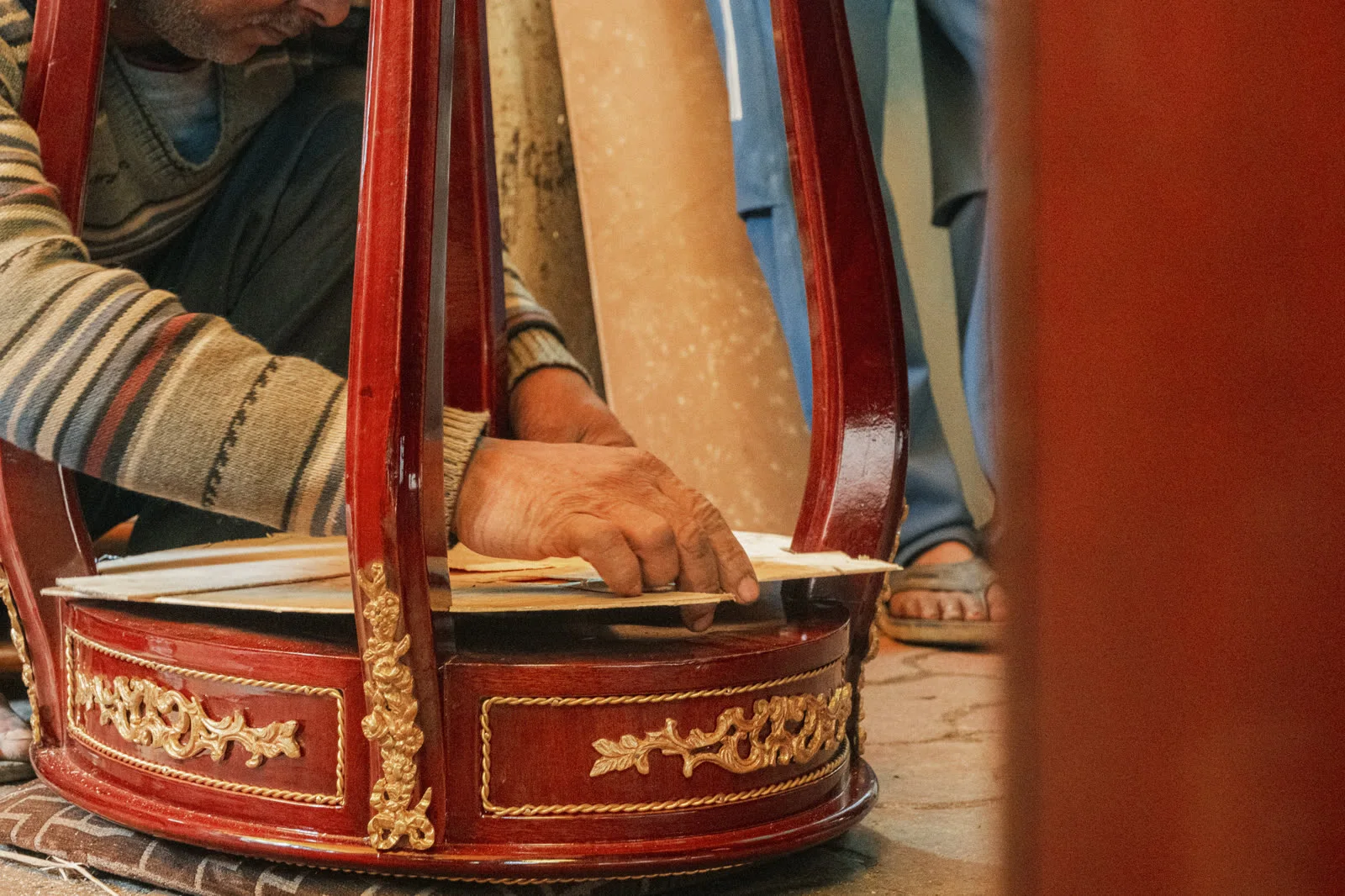
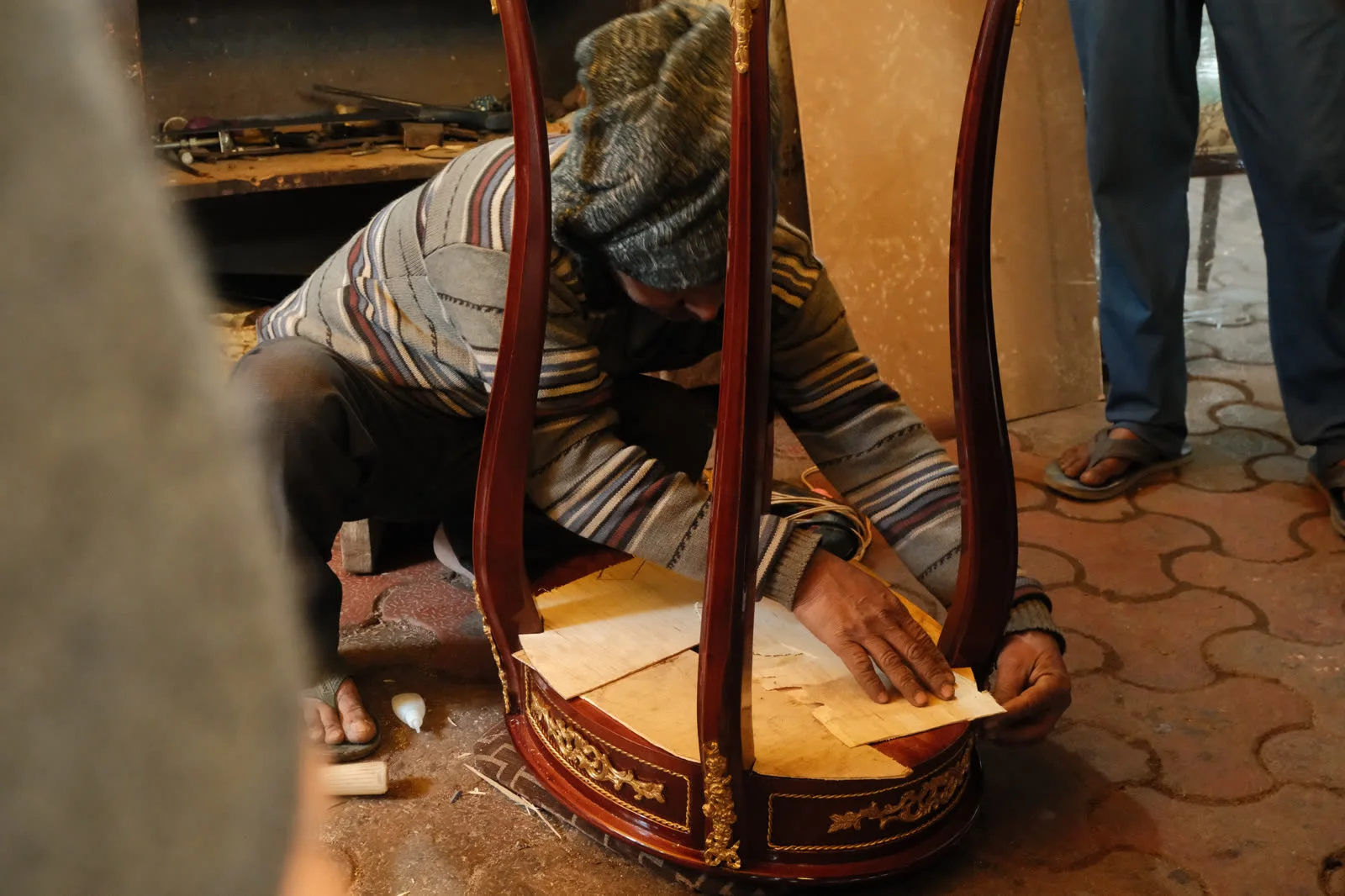
A craftsman reassembling an ornate lacquered vitrine
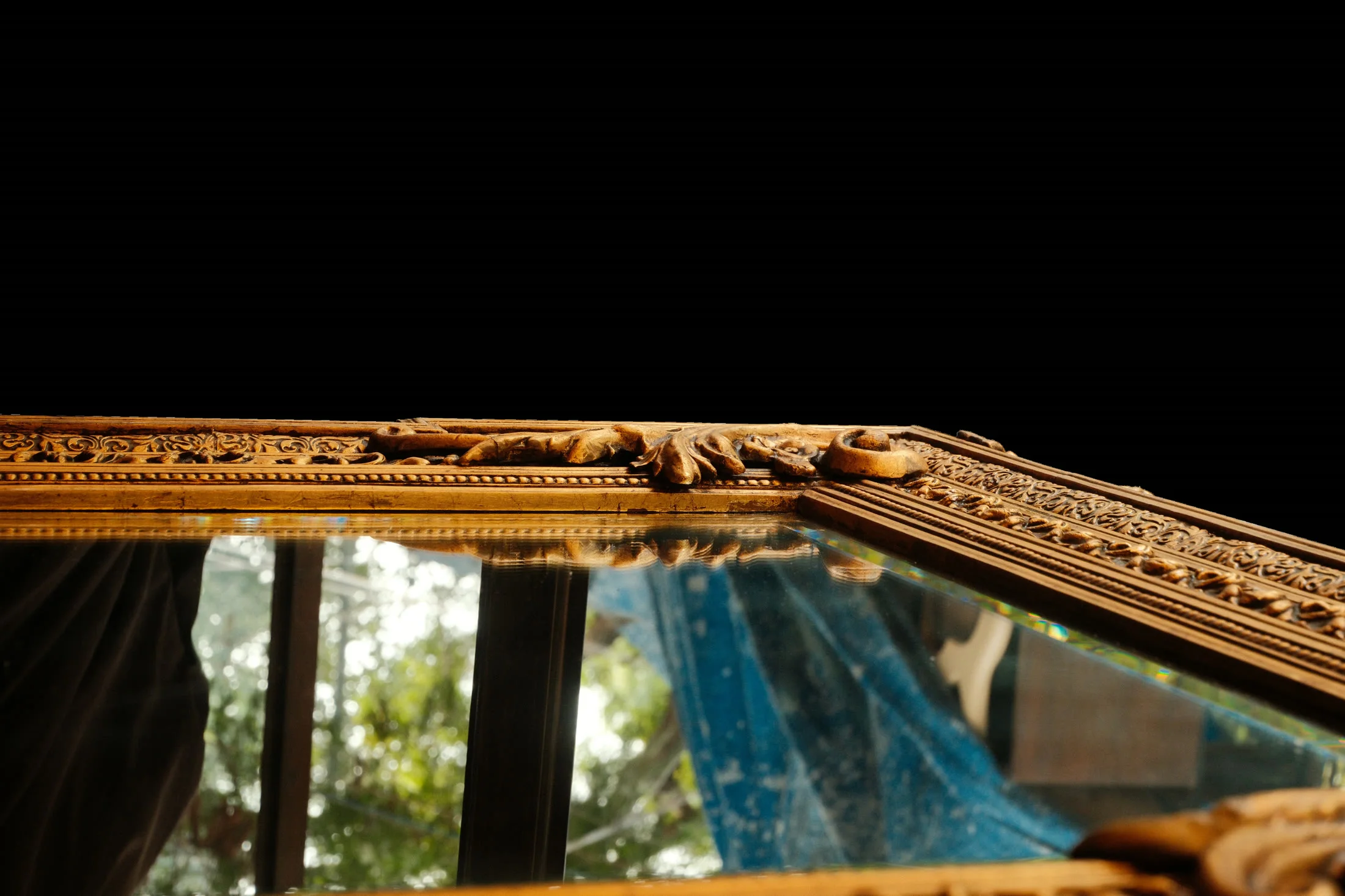
A teak-framed mirror among the stacked furniture of the market

log

(people)

displaced from their lands, they build new ground, dream by dream

A hierarchy measured in dust

This hierarchy defines the flow of value and labor in Amar Colony, where status is marked by physical proximity to the dust of production.
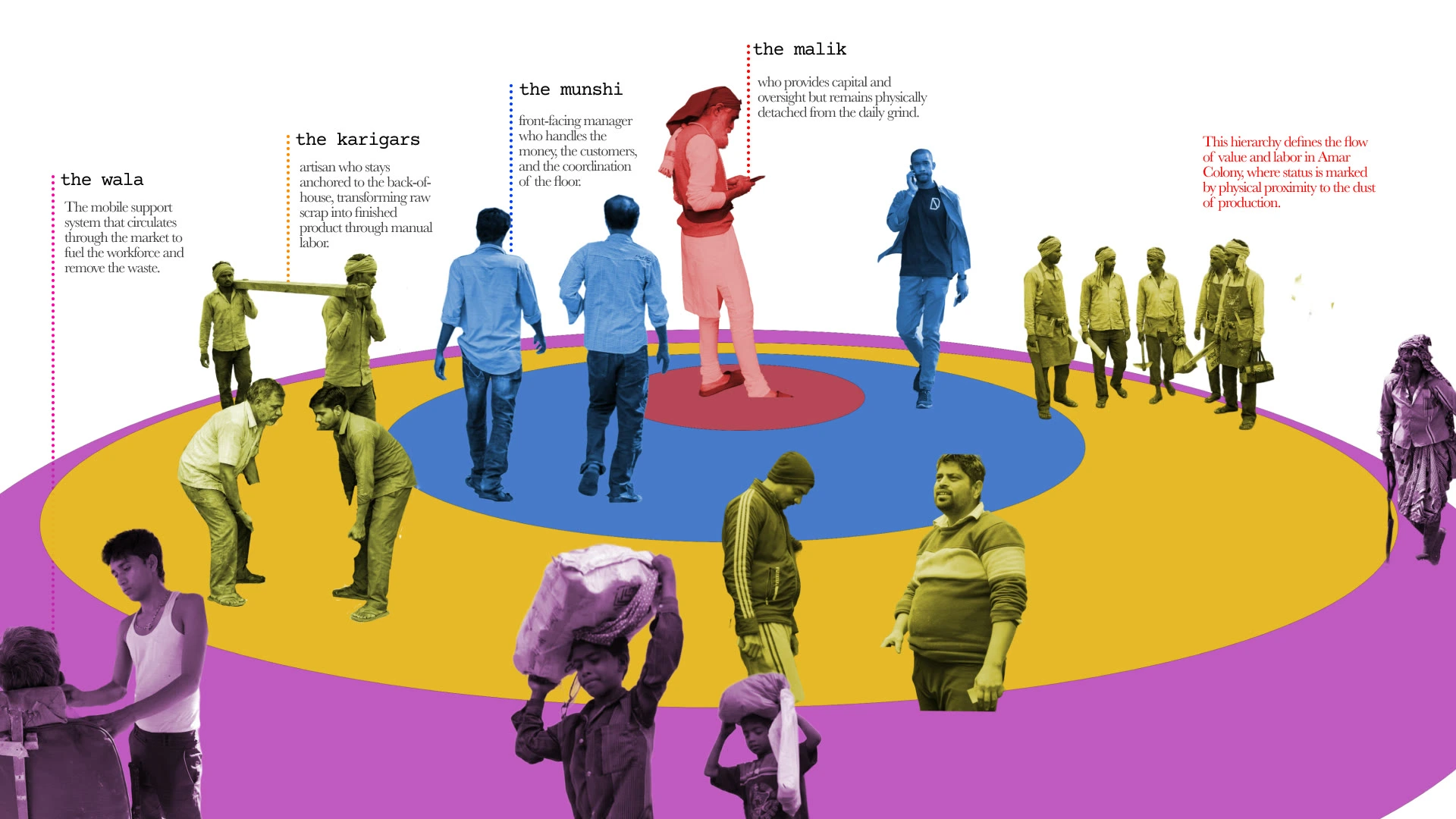
The market's labour hierarchy — the wala, the karigars, the munshi and the malik — arranged on concentric rings by proximity to the dust of production
A craftsman using makeshift tools on a piece of furniture
Craftsmen rely on makeshift tools. Accustomed to working with fragments, they recognize value in discarded objects and survive using skilled adaptation.
Men at work in the market, whose labour shapes its masculine gaze
The labor of the market is performed almost entirely by men. As a result, the market's dynamics are shaped by a distinctly masculine gaze.
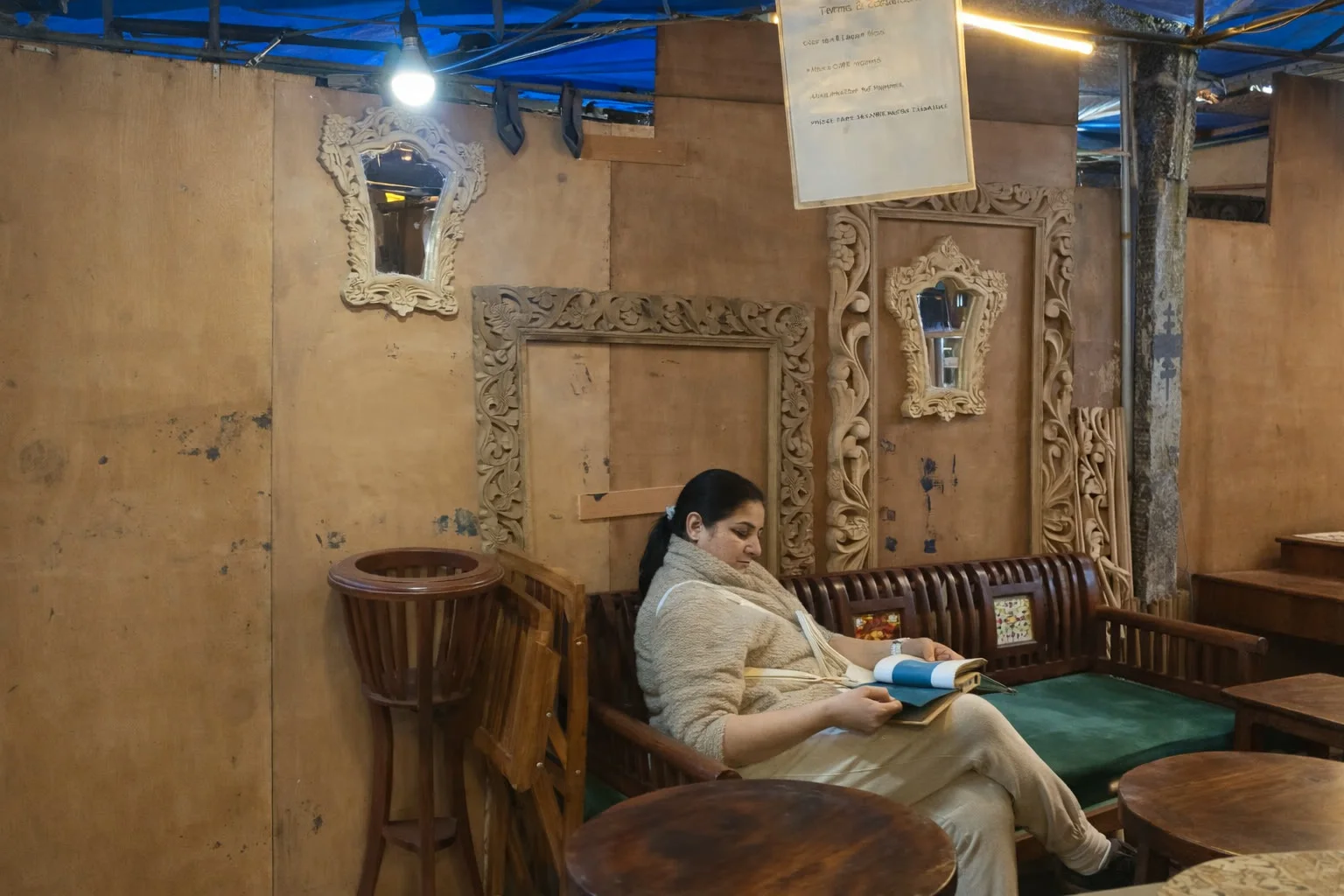
A female customer seated among carved mirror frames inside a store
Notably, the clientele is frequently female, introducing a contrast between the market's masculine labor. Customers enter the store with reference images, making the screen an active browsing tool.
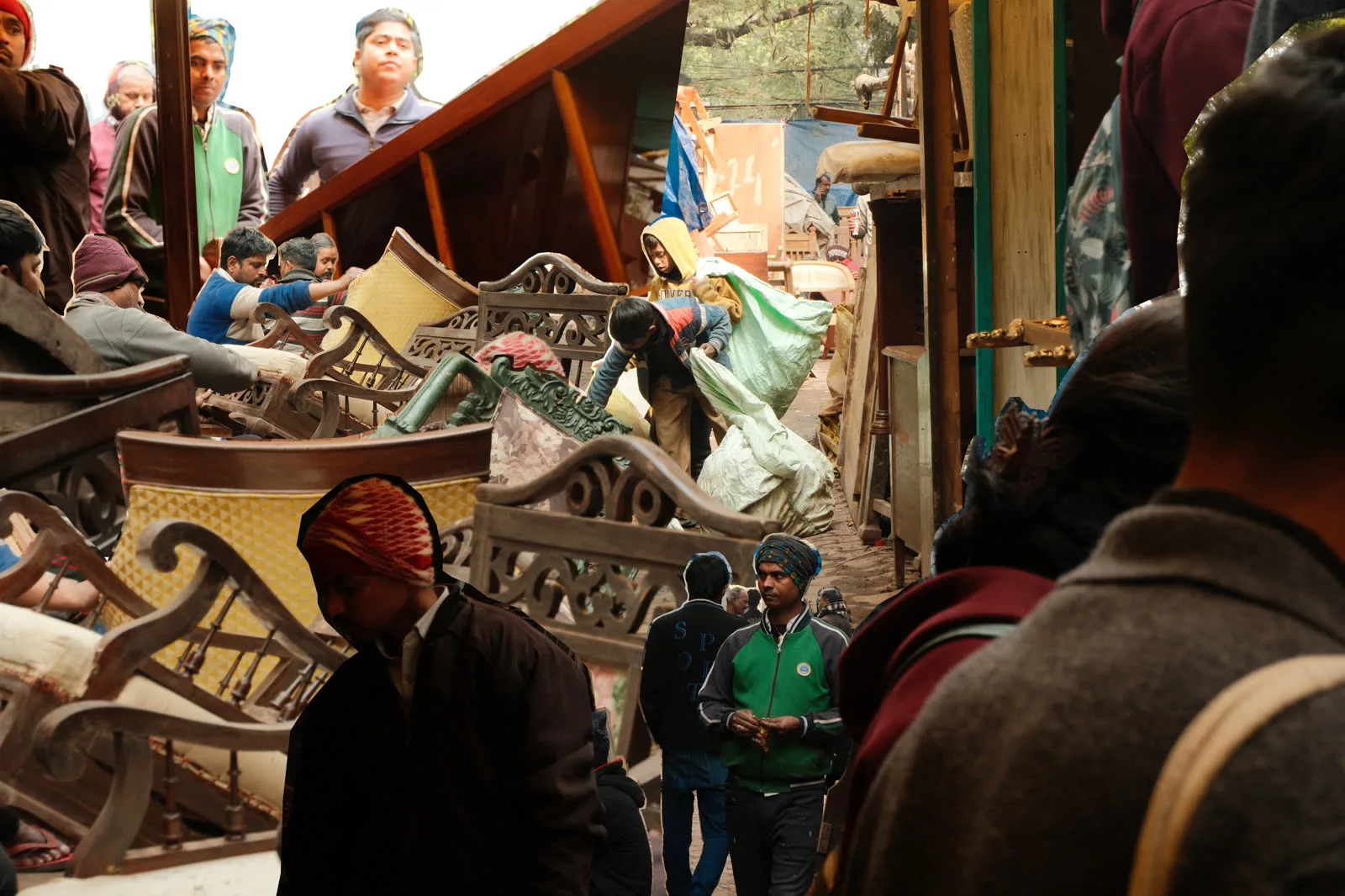
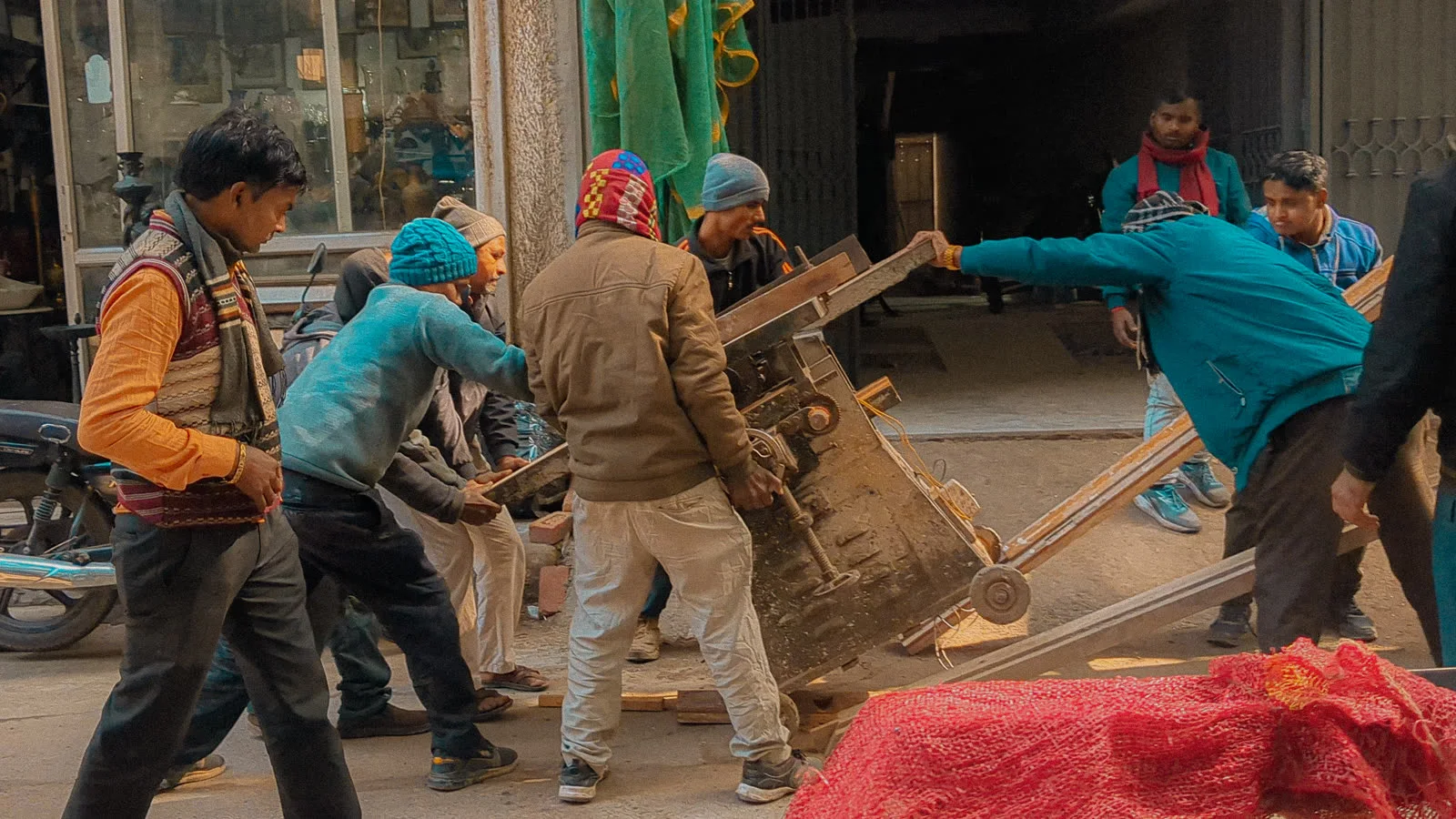
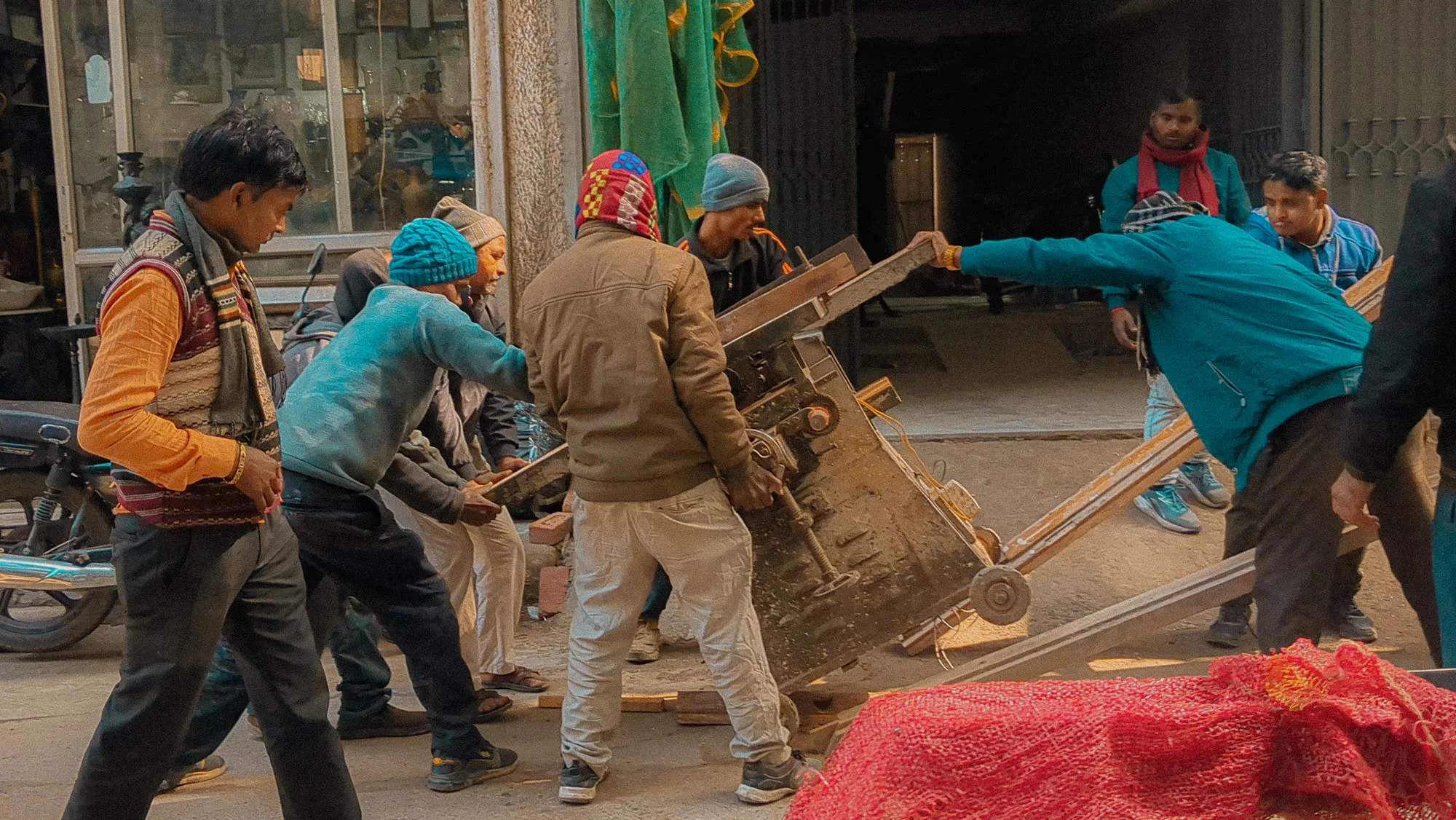
Men hauling a heavy cabinet through the lane on a handcart
Owing to the market's informal structure, stores lack doors that can be locked at night, requiring shopkeepers to double down as night security. Along with this CCTV cameras surveil the lanes, securing the market's most valuable objects.
A cycle-rickshaw loader balancing furniture through the lanes
An additional layer of labor within the market is formed by cycle-rickshaw loaders, whose work depends on an intuitive understanding of balance and weight.

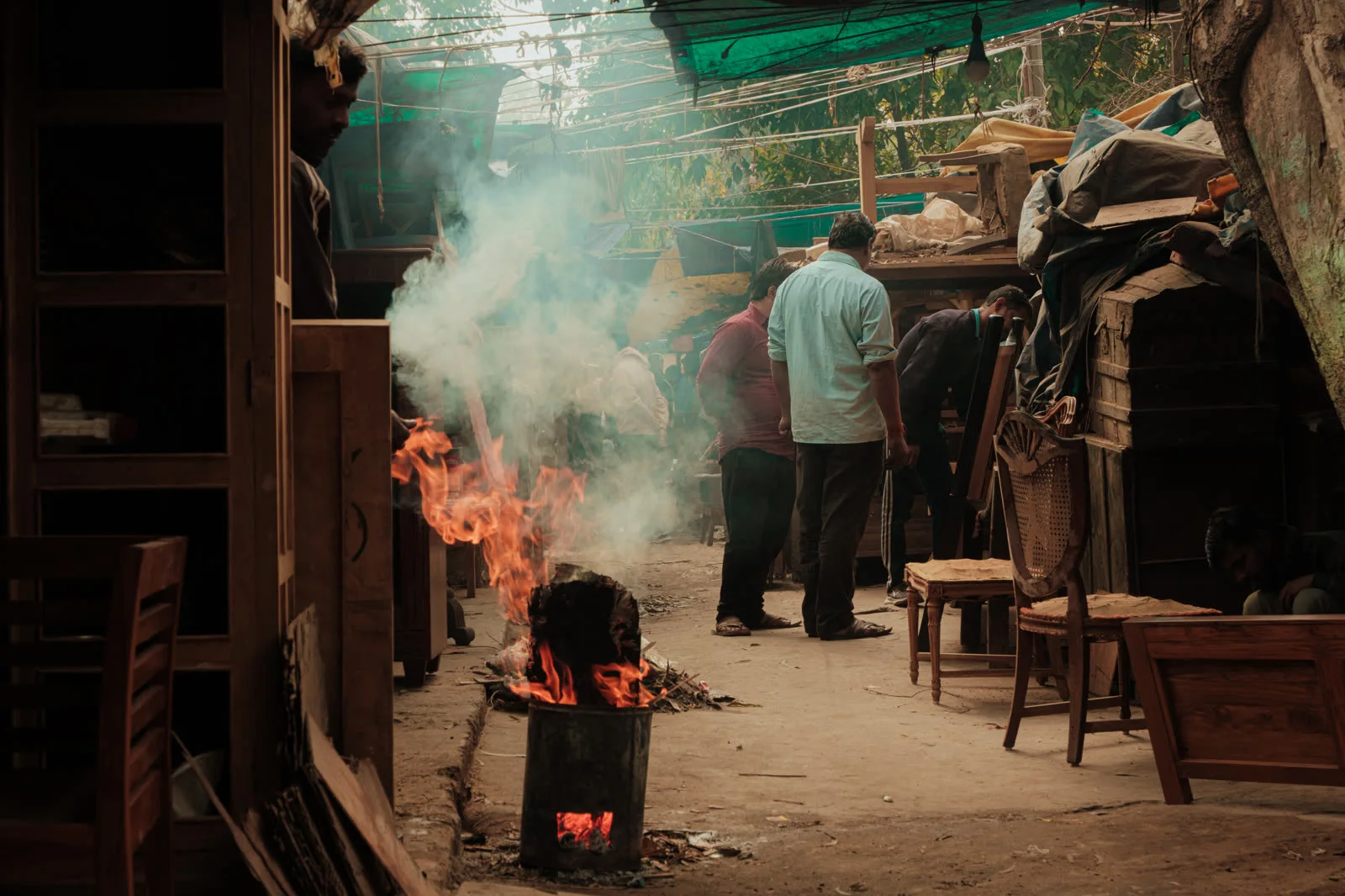
Nothing is discarded; every fragment becomes fuel or filler. Amar Colony operates on a zero-waste logic driven not by environmental intent, but by economic necessity.
Workers around a fire of wood offcuts burning in the lane
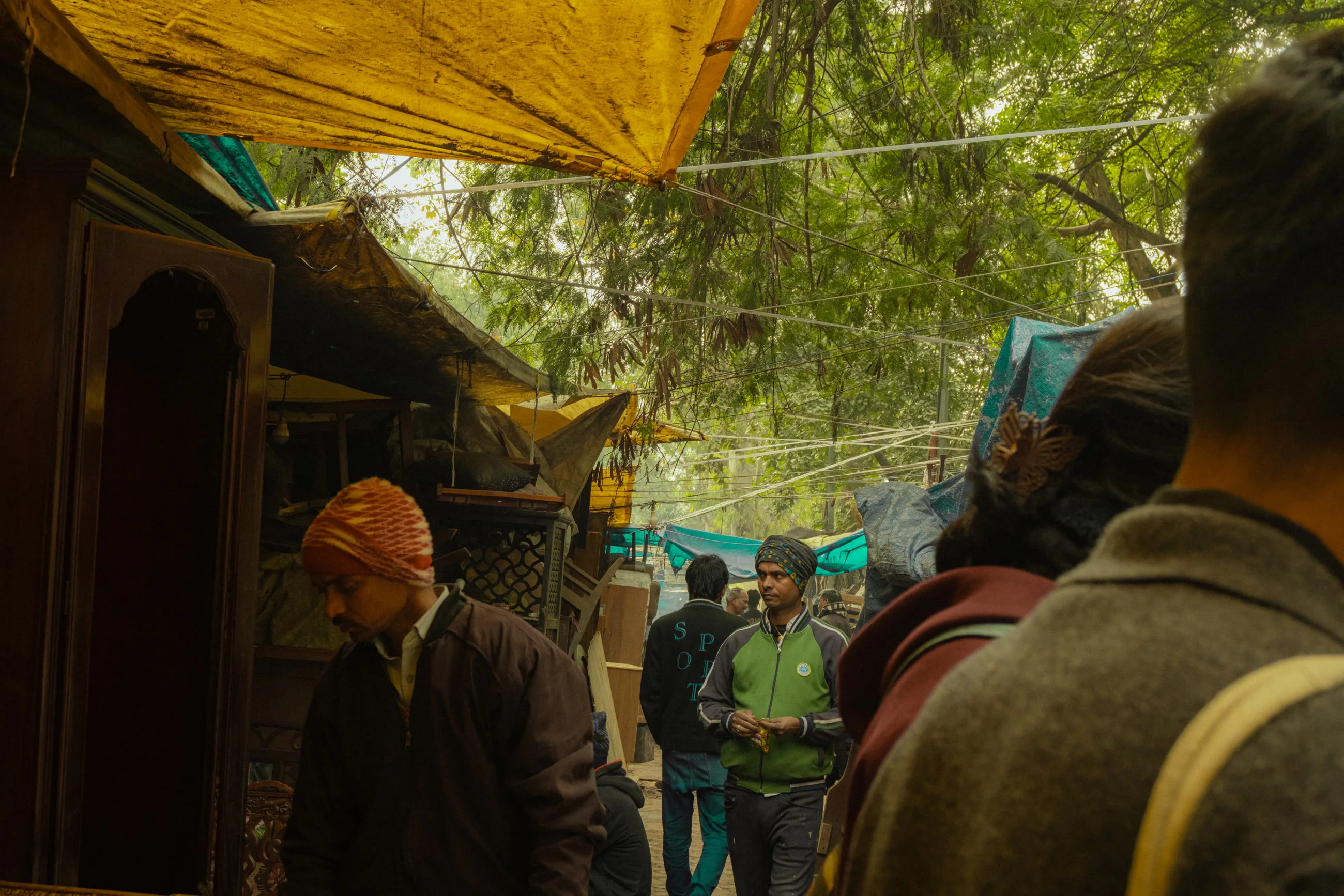
A lane of the market under green netting, dappled with winter light
Mahaul

(surroundings)

displaced from their lands, they build new ground, dream by dream

Anatomy of a unit store

Each store folds back into itself — a public face for selling, a dusty backstage for making. The illusion of the showroom is built just behind the curtain.
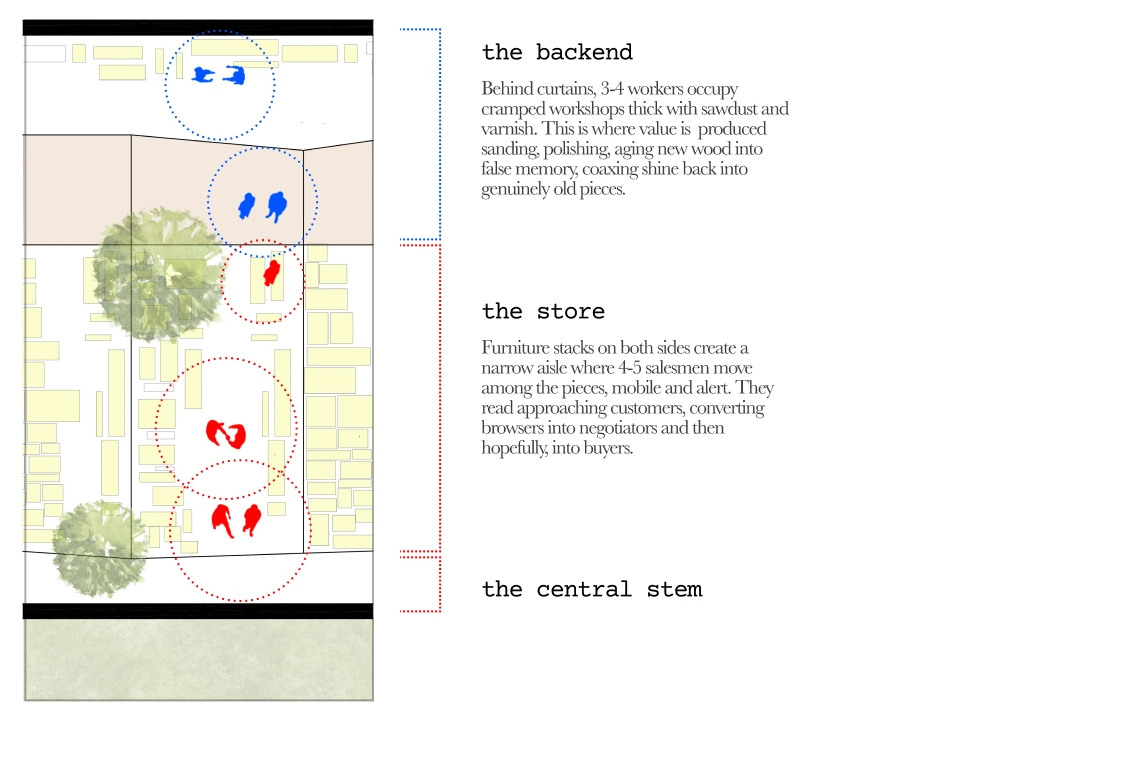
A sectional plan of a unit store — the backend, the store and the central stem
The dusty backstage workshop where pieces are sanded and aged
The dusty backstage where the showroom's illusion is built.
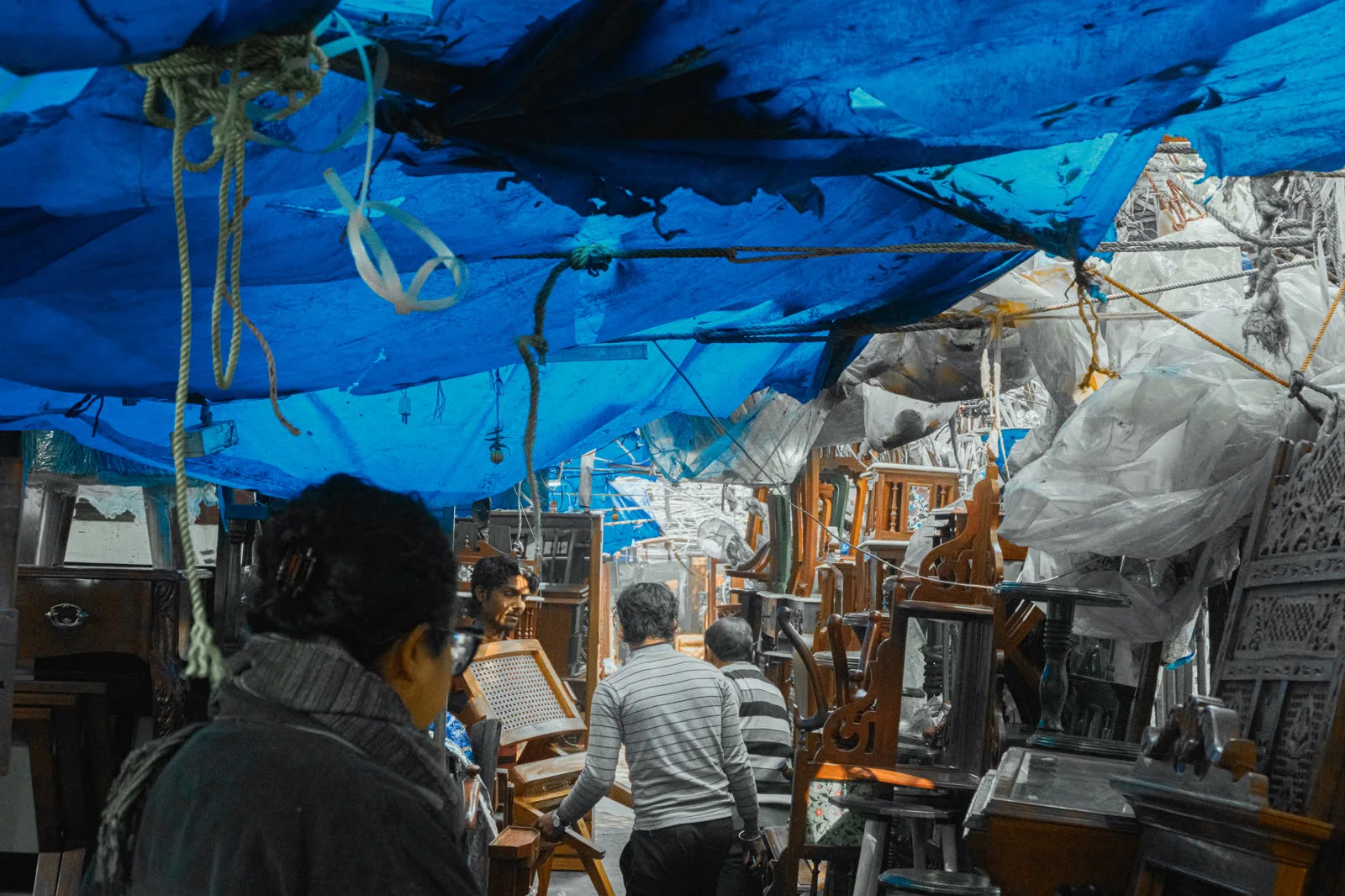
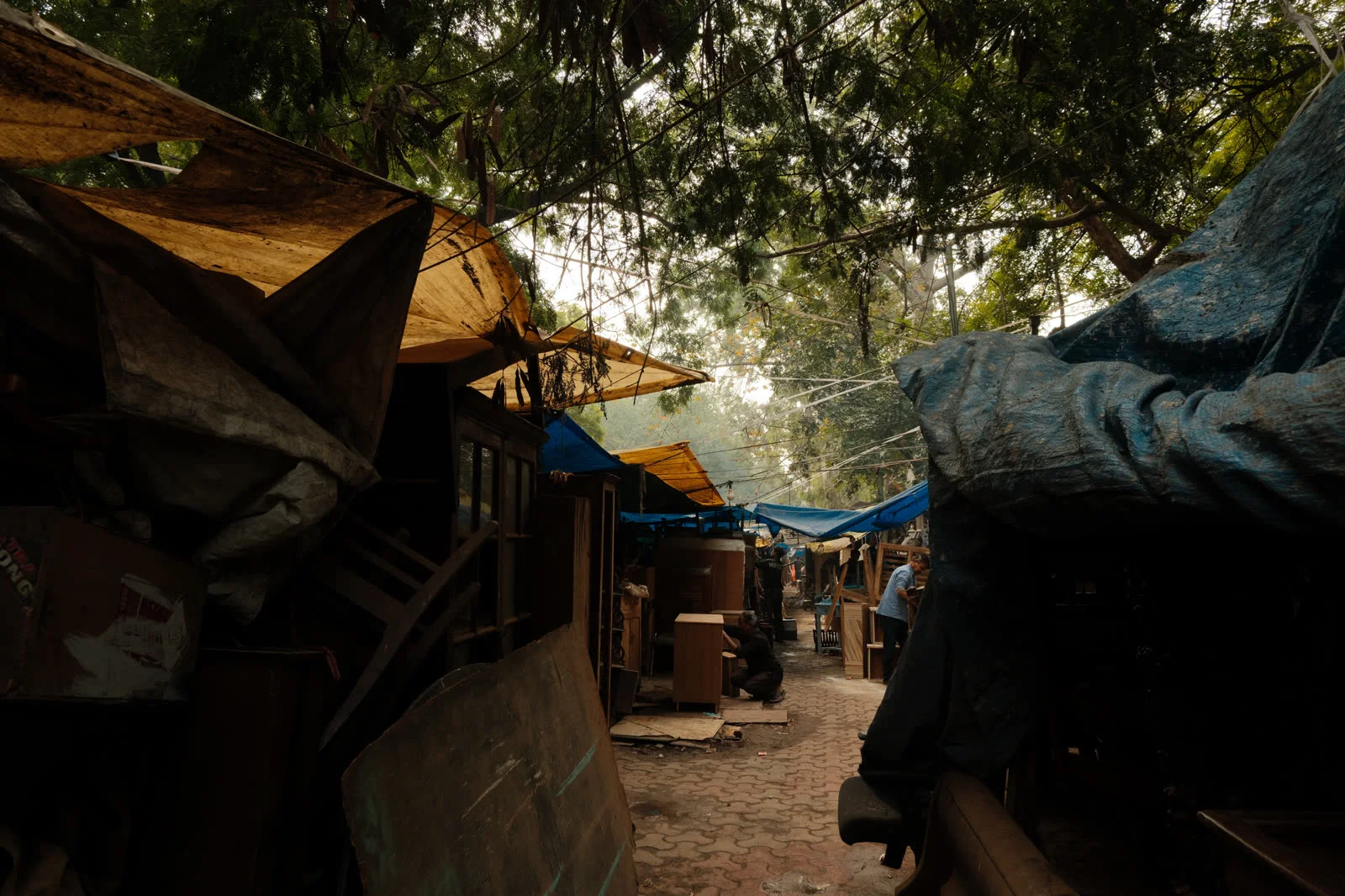
Blue tarpaulin sheets stretched overhead as a makeshift ceiling
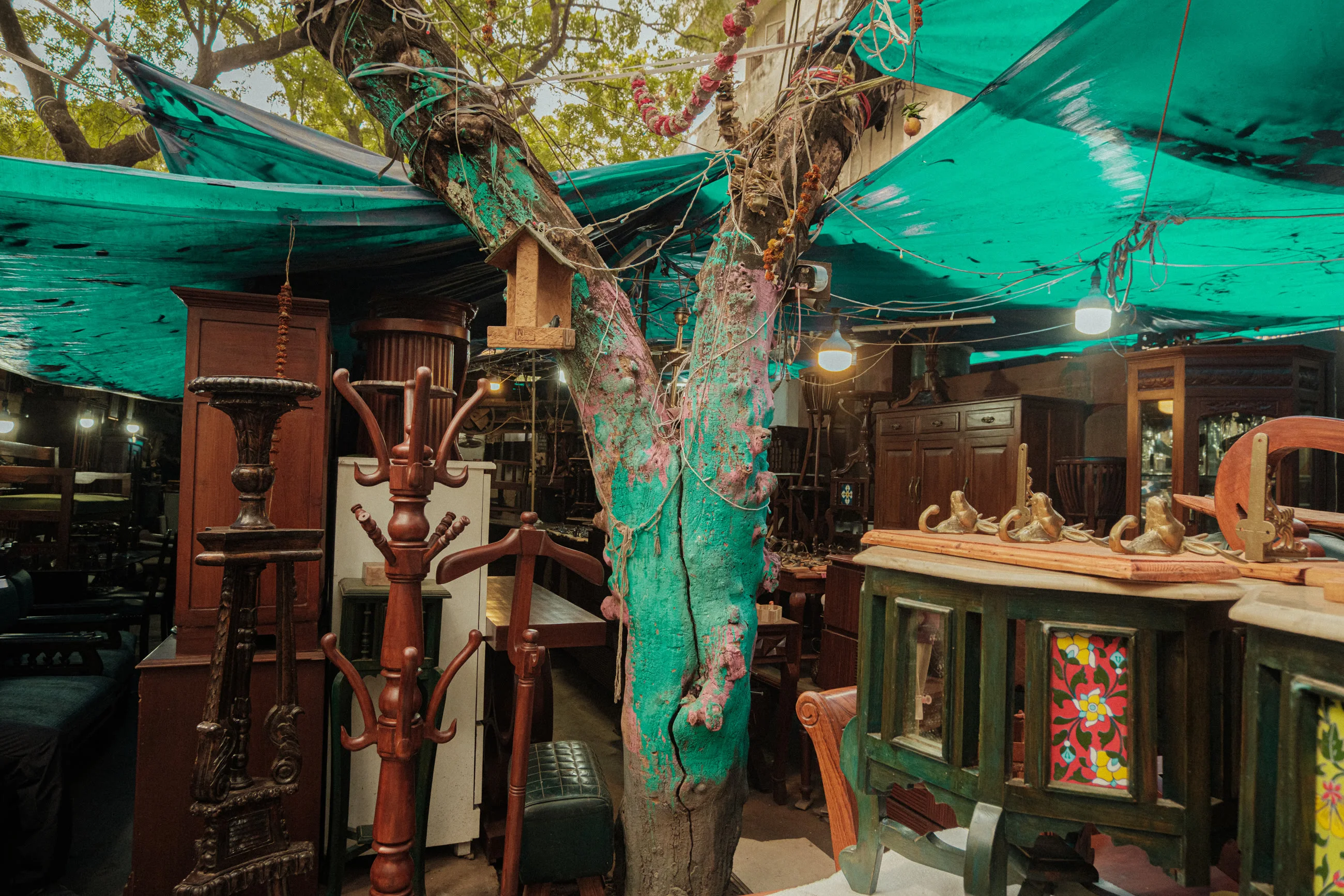
Blue tarpaulin sheets stretch overhead as makeshift ceilings, diffusing daylight into a muted glow. They trap the scent of varnish below, enclosing the market in a suspended, workshop-like atmosphere.

The sharp bite of spirit polish mingles with the damp scent of old wood, signalling that work is constantly underway amid the rhythmic scrape of sanding and tearing tape. Dust settles on everything, making the market an inescapably gritty, tactile experience for its visitors.
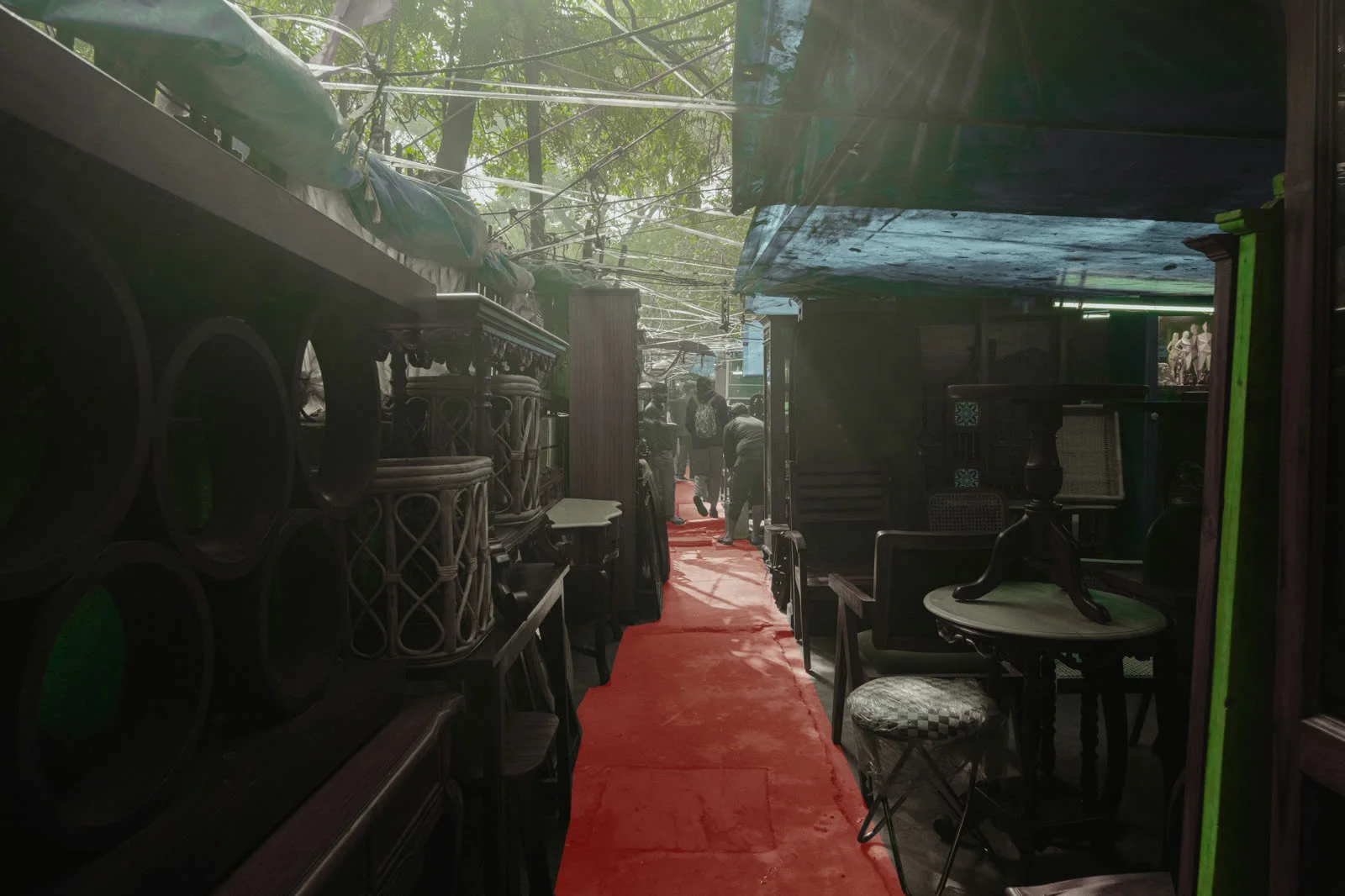
A narrow aisle with a red runner cut between stacks of furniture
Narrow aisles are carved out between stacks of furniture. These shifting passages reflect the market's organic growth, shaped by accumulation, movement and need.
A craftsman working low over a lacquered piece, surrounded by tools
Along the service lane lie piles of detached legs, handles and carved panels, kept as spare parts for future creations. Even unusable wood finds purpose, burned in winter fires to warm the workers, leaving almost nothing without value.
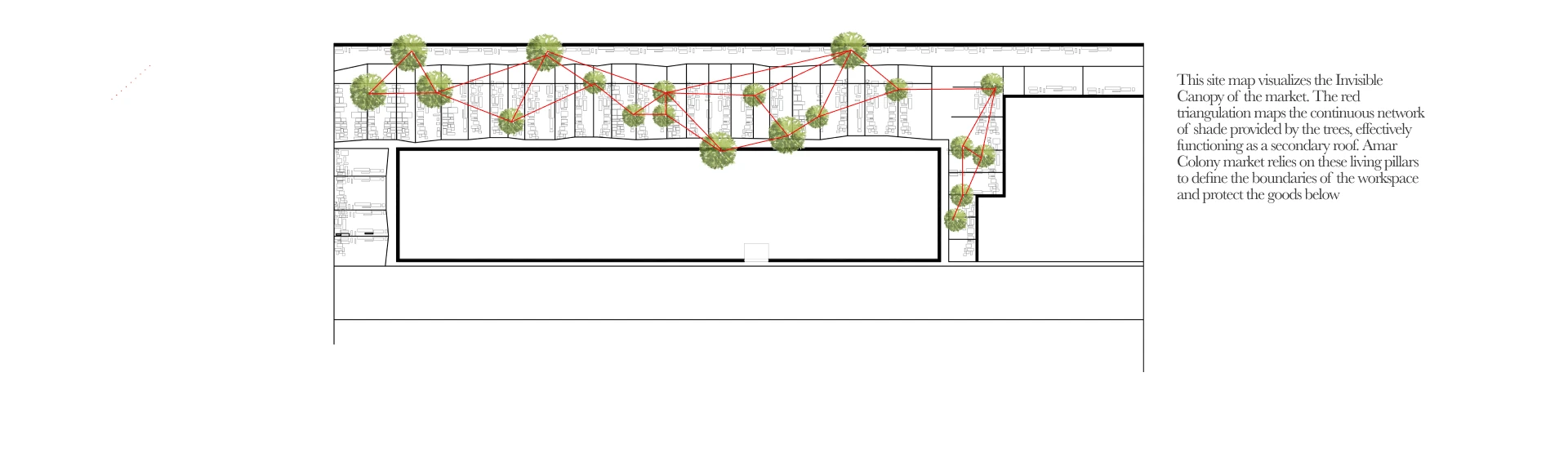
A site-map drawing showing the red triangulation of the market's tree canopy
The invisible canopy — a continuous network of tree-shade mapped as a secondary roof.
Antique furniture beneath a teal tarpaulin canopy with a tree growing through

So we wondered, what was missing?

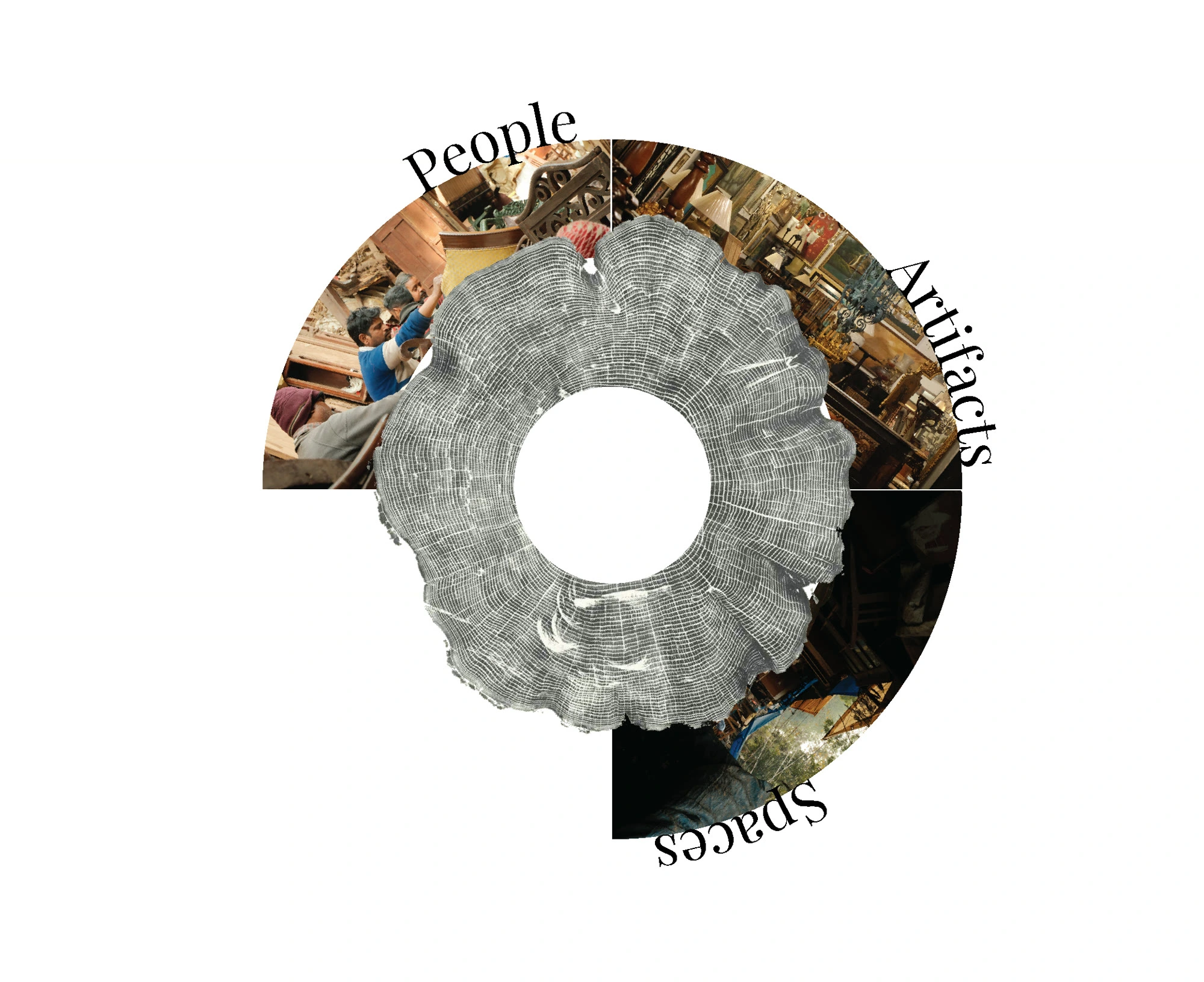
The three lenses of the study — artifacts, people and spaces — arranged around a tree-ring section

The artifacts need the people's skills to transform. The people need the artifacts for their livelihoods. The spaces enable encounters between the two.

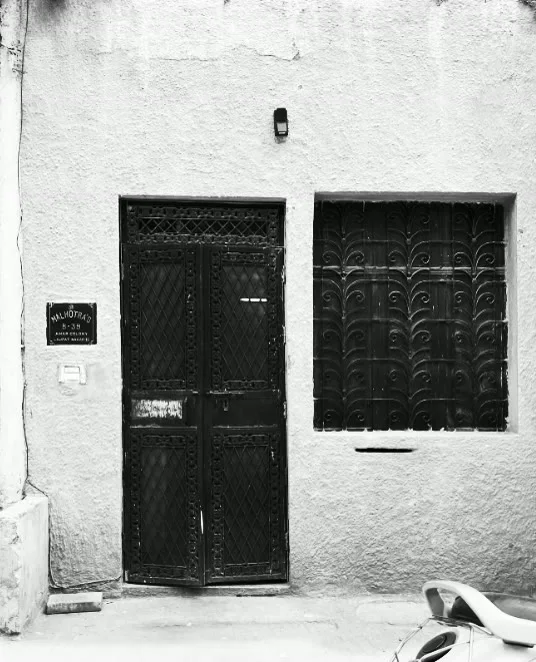
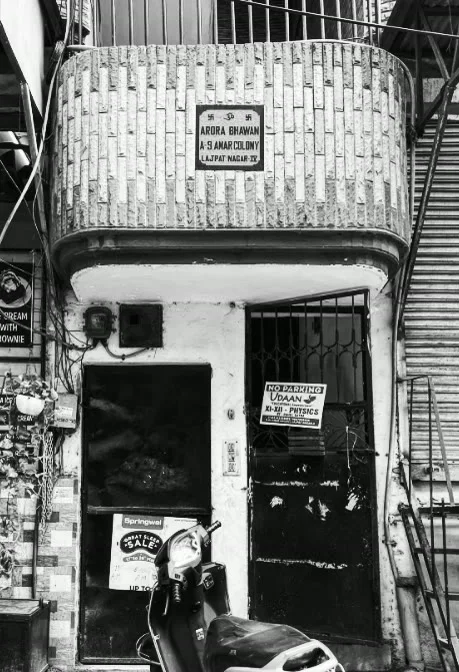
And Amar Colony's history of displacement sets the stage for the furniture market's emergence.

Rebuilding a fractured past, one piece at a time.

Partition seems like a chapter in a history text book but lives on through these communities.
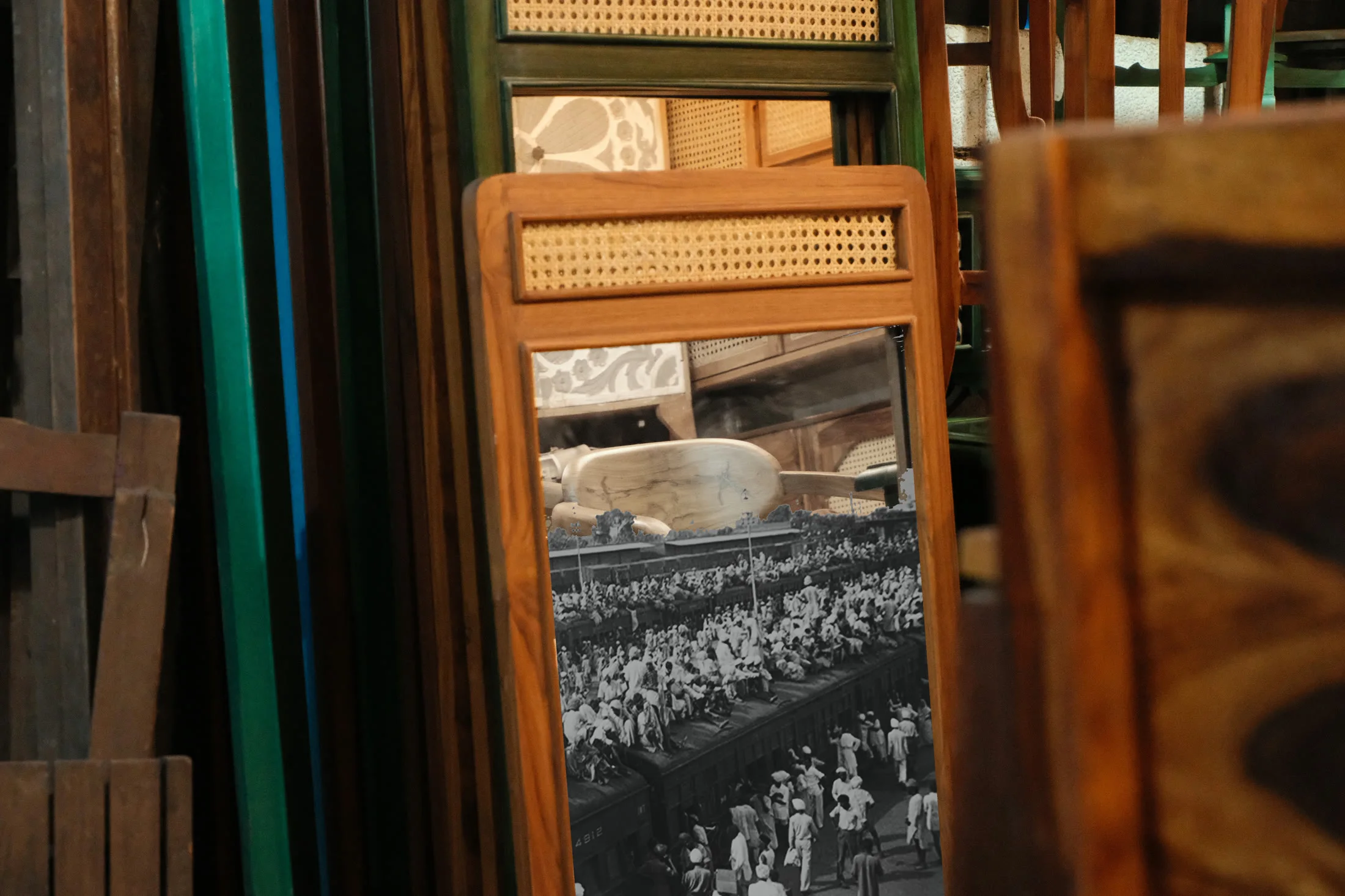
A Partition-era archival photograph reflected in a teak mirror among the furniture
Archival fragment of the settlers' past

amar

"immortal" or "everlasting" in Hindi, chosen to represent the resilience, endurance and hope for a new, permanent beginning for the settlers.
The value of a second life

The furniture market is more than a trade place. It is an metabolic ecosystem. It functions as a decentralized processing plant where the city's discard is metabolized into value. Through a rigid hierarchy of invisible labor, material alchemy and negotiated authenticity, the market bridges the gap between the chaotic reality of the street and the curated aesthetic of our modern home. It proves that in Delhi, nothing is ever truly thrown away. It simply waits for the right hand to sand it down, polish it and sell it as a story.

Special thanks to all the shopkeepers, craftsmen and people of Amar Colony.
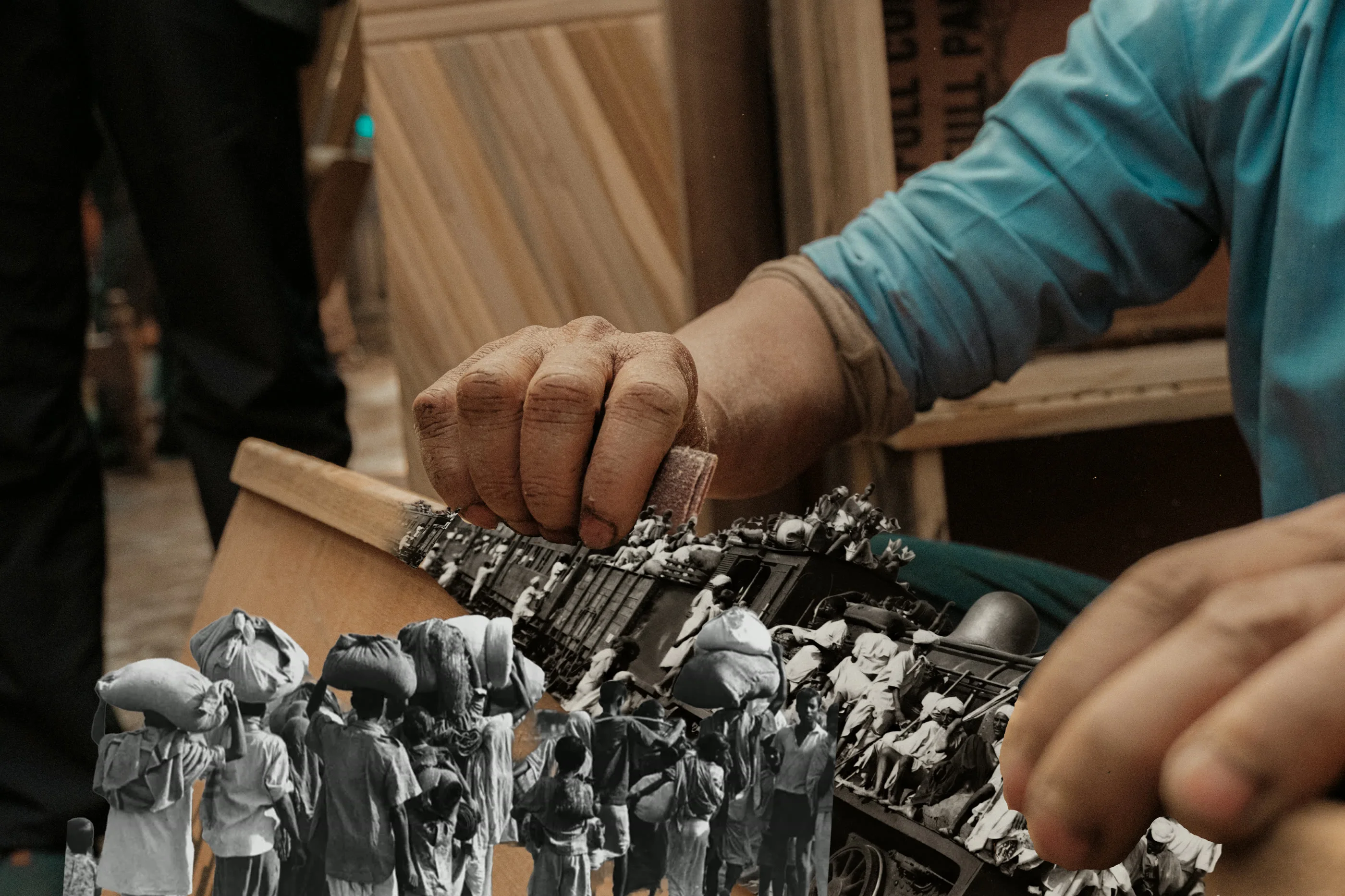
A craftsman's hand at work over a black-and-white Partition photograph of refugees and a crowded train
Displacement is not always destructive; with the right ecosystem, it becomes a generative force.

Nothing is ever
truly thrown away.

← Back to Work