Cycle Parking
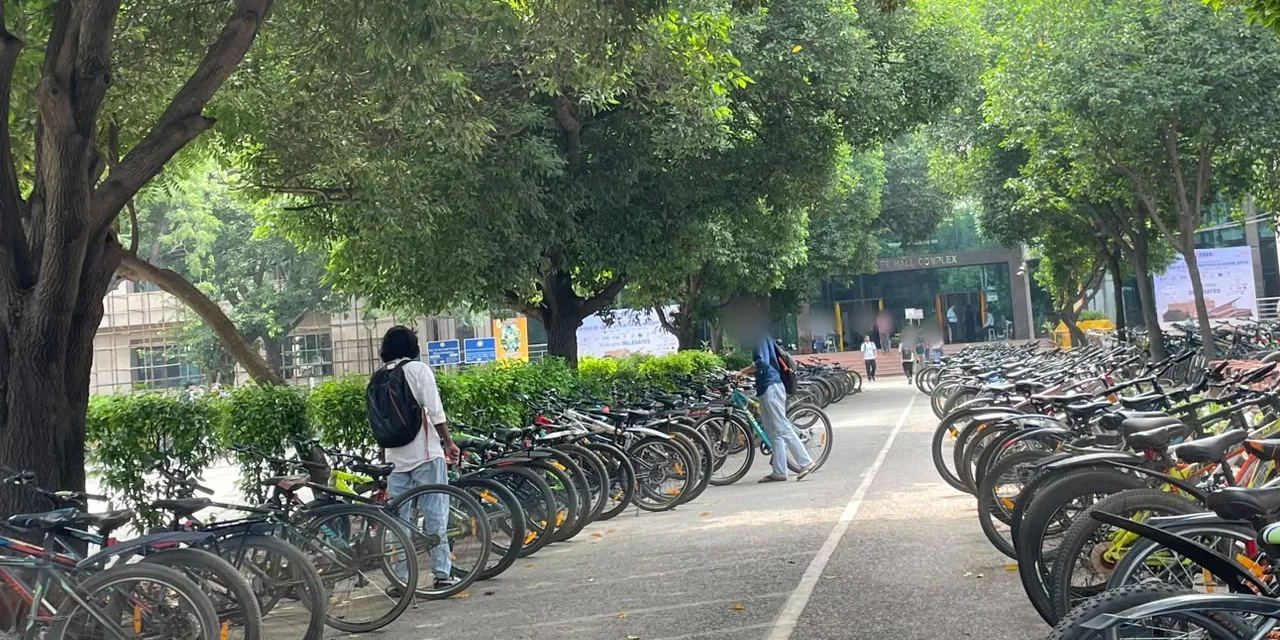
How riders park a cycle in the lane outside the Lecture Hall Complex, and what in the lane decides where they leave it.
A team project for DDL7026 Applied Behavioural Design, taught by Prof. Pramod Khadilkar in the Department of Design, IIT Delhi, 2026. Made with Mojum, Radhika, Zeva and Sruthi.
The methods were open observation, task analysis, timed observation in two windows, and photographs of each parked cycle.
The lane runs south from IIT Delhi Main Road to the lecture hall complex. Cycles stand in rows along both kerbs, with a through lane left between them for riders and people on foot. Over two windows of a teaching day the team watched what riders did in the lane, chose one behaviour that repeats often enough to be timed, broke it into its steps, and recorded 46 instances of it together with the cycle each rider left behind.
The campus provides bars for locking cycles along the lane. A free bar stood within twenty metres of the rider in 39 of those instances, and riders used one in 3. The study follows that gap through the rider's decisions, the cues the lane offers, and the measures taken in each window.
Two windows on one lane
The lane was observed from one fixed position in two windows, chosen to differ in how full the near end was. The near end is the twenty metres closest to the lecture hall, where riders try first to park.
Window one, 8.45 to 9.30 am
The first window falls before the first class. Occupancy of the near twenty metres rises from about thirty per cent to about eighty per cent across it. Riders arrive under time pressure, and several enter the lane within the same minute.
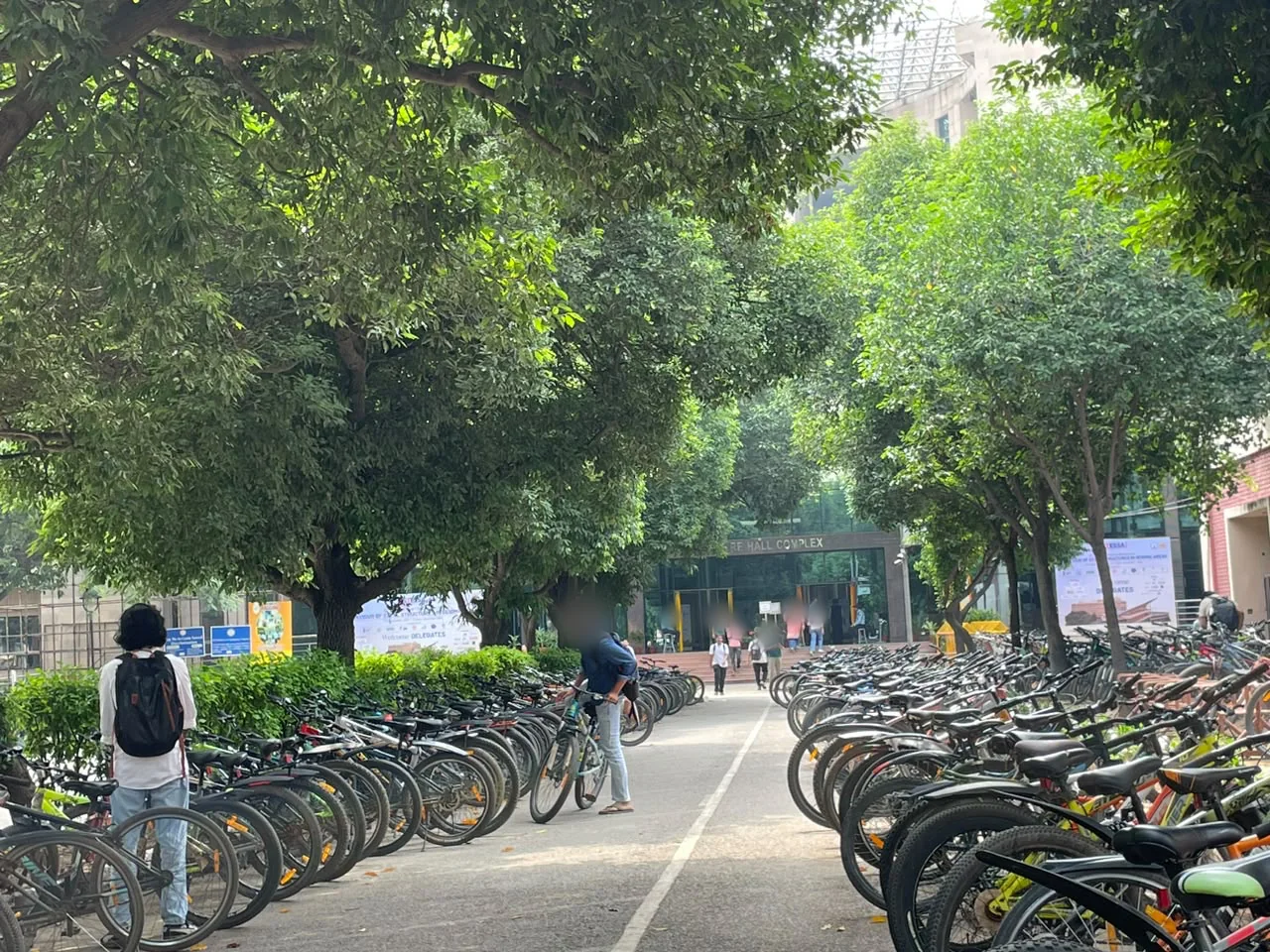
Window two, 11.50 am to 12.10 pm
The second window falls at the changeover between classes. The near twenty metres is at or close to capacity throughout, so riders must ride further back along the lane or accept a narrower gap.
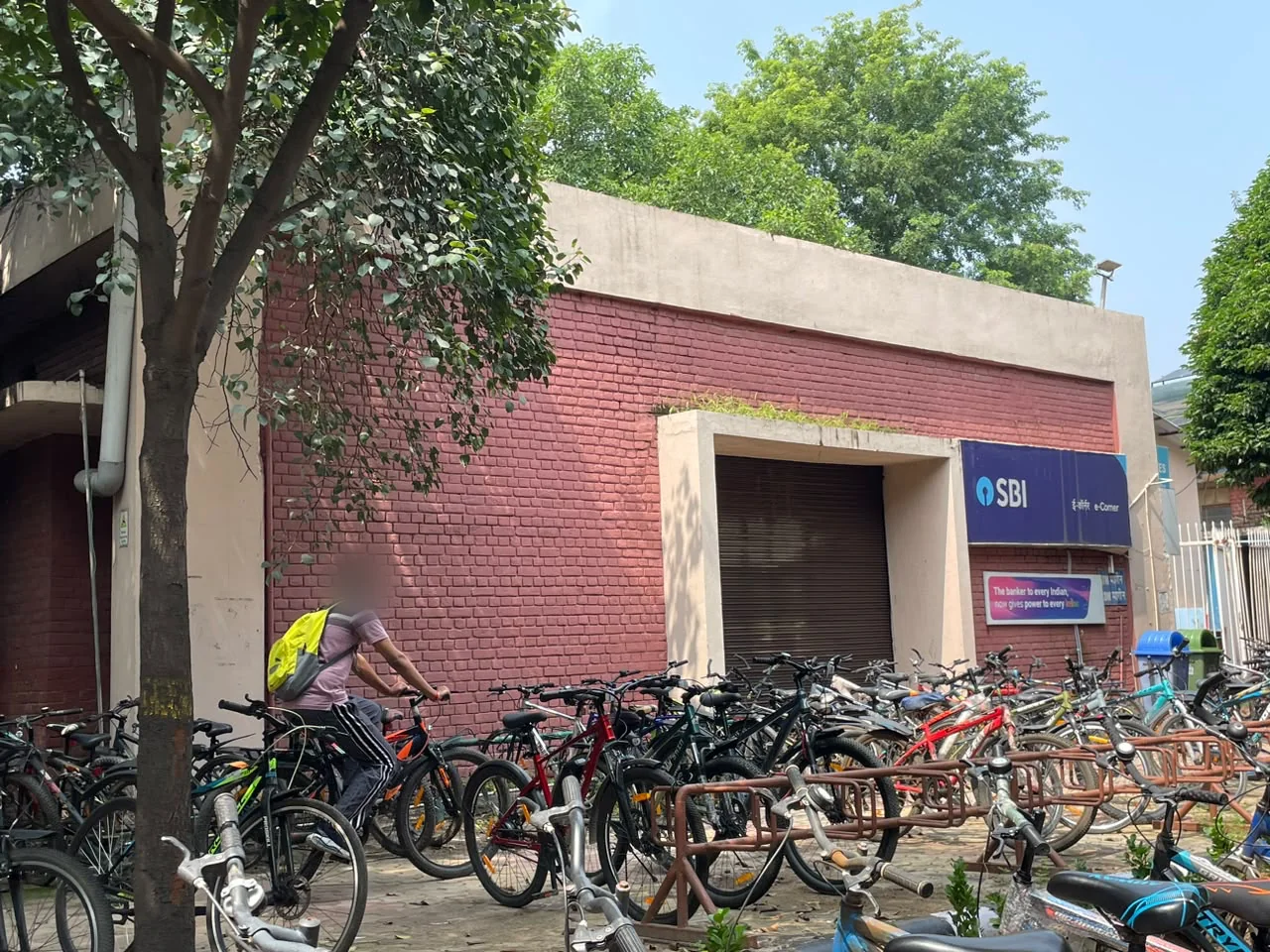
Choosing the behaviour
A first round of open observation recorded twelve behaviours in the lane. Riding in and parking occurred most often, contained the most decisions, and left a physical result that could still be observed after the rider had gone. It became the focus, and from that point the observation was closed ended. The behaviours involving the bars and the marked zone were kept as cues rather than measured.
- Riding into the lane and parking
- Retrieving a cycle and riding out
- Walking the lane on foot to the lecture hall
- Riding past empty bars toward the entrance
- Waiting for someone to vacate a place near the entrance
- Parking in the marked no parking zone
- Locking, and unlocking on return
- Riding the full lane and doubling back
- Parking on the footpath beside the SBI bay
- Lifting a cycle over a kerb to reach a bar
- Moving or lifting a neighbour’s cycle to make room
- Leaving a cycle resting against a neighbour
Parking meets all five selection criteria
- Frequency
- Twenty or more entries to the lane within a twenty minute window, which is enough for repeated timing within a single session.
- Decomposition
- Four sub behaviours containing nineteen steps and six decisions, which permits a flow chart with branch points rather than a single sequence.
- Targets and interfaces
- Kerb edge, gaps between parked cycles, adjacent cycles, the bars and the level change at their edge, tree guards and poles, kickstand, ring lock, cable and key. Visual, manual, pedal and auditory interfaces are all involved.
- Response product
- The parked cycle remains observable and can be photographed after the rider has left, which permits a product measure alongside live observation.
- Context variation
- The behaviour occurs with the near end of the lane part filled and again with it at capacity, which permits comparison between windows at one site.
Where an instance starts and ends
An instance starts when the front wheel crosses into the lane at the northern end, and ends when the rider releases the cycle and steps toward the lecture hall. The end state returns the rider to a position from which the same behaviour can be emitted again, which satisfies the definition of a movement cycle. A rider who enters the lane and leaves without parking is recorded as an aborted instance and kept in the log.
- t0The front wheel crosses into the lane at the northern end. Always zero.
- t1The cycle stops moving toward the chosen gap.
- t2The lock engages, or the rider begins to walk away if no lock is used.
- t3The first step away, toward the lecture hall.
Nineteen steps, six decisions
Parking breaks into four sub behaviours, arriving in the lane, positioning the cycle, securing it and departing. Six of the nineteen steps are decisions, shown filled. Each one draws on cues outside the rider, which can be seen in the lane, and on cues inside the rider such as time pressure or habit.
Arriving in the lane
Turn into the lane and ride toward the lecture hall
Scan the parked rows on both sides while riding
Decision. Continue toward the far end, or take an earlier gap
- Outside
- Occupied length ahead, visible gaps
- Inside
- Time pressure, the usual position
Brake and place one foot on the ground
Dismount and take hold of the handlebar
Riders slow down while scanning the rows. Some stay mounted and ride slowly into the gap.
Positioning
Decision. Choose a gap, trading distance against width
- Outside
- Gap width, kerb, adjacent cycles, whether a bar is free
- Inside
- Tolerance for a tight gap, effort of the level change
Wheel into the gap and turn to face out of the lane
Decision. Choose a support, own stand, a neighbour, or a tree
- Outside
- Kickstand, ground, neighbour, tree guard
- Inside
- Concern for the cycle, past experience
Deploy the stand or settle against the support
Decision. Judge stability and clearance of the through lane
- Outside
- Slope, neighbour contact, lane width left
- Inside
- Experience of cycles falling
Adjust, or move a neighbouring cycle
Securing
Retrieve the cable, or reach for the ring lock
Decision. Choose what to secure, wheel, frame, or a fixed element
- Outside
- Cable reach, whether a bar or fixed element is reachable
- Inside
- Perceived theft risk, habit, awareness of guard checks
Thread the cable, or close the ring lock
Engage the lock and withdraw the key
Tug the lock to verify engagement
Departing
Retrieve belongings from the basket or carrier
Decision. Decide whether to check the cycle again
- Outside
- Visibility of the cycle from the lane
- Inside
- Residual doubt about the lock
Turn to the lecture hall and step away
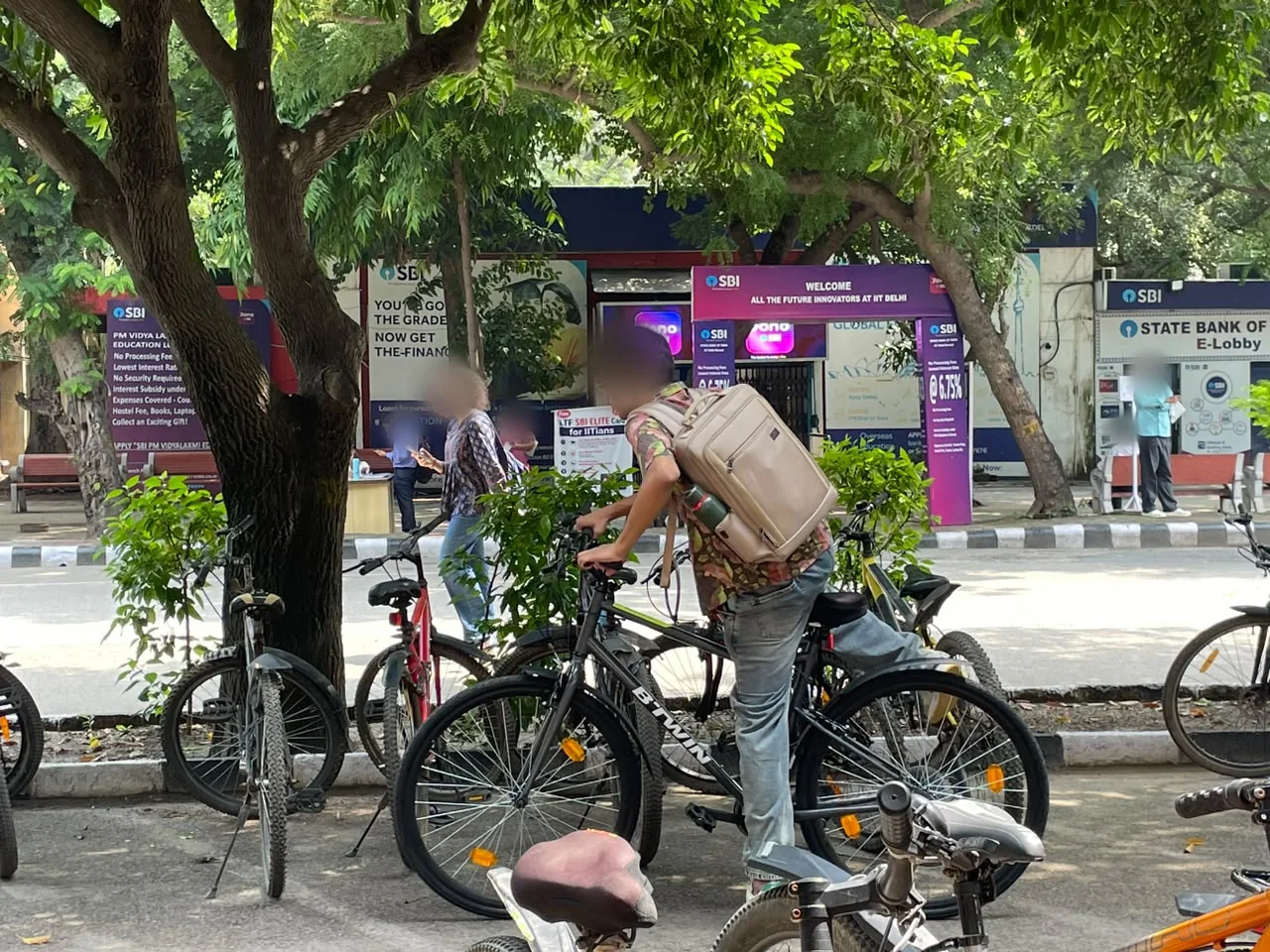
What counts as a successful parking
Functional
This definition applies to arriving, positioning and departing. The cycle is left within the parking rows, standing without being held, clear of the through lane, and secured so that it cannot be ridden away by another person.
The form of the actions is not constrained. A rider who uses the kickstand and one who settles the cycle against a tree guard both satisfy the definition.
Topographical
This definition applies to securing. The lock passes through the frame and either the rear wheel or a fixed element such as a bar, tree guard or railing, the lock body is engaged to an audible or tactile click, and the key is withdrawn.
Bars are provided but are sited off the route and are largely unused, so in practice a fixed element is rarely within reach of the position the rider has chosen.
Field notes
Notes gathered by the team alongside the timed observation suggest that riders choose where to park by where other cycles already stand. They are not counted instances and are reported apart from the log.
Environmental cues
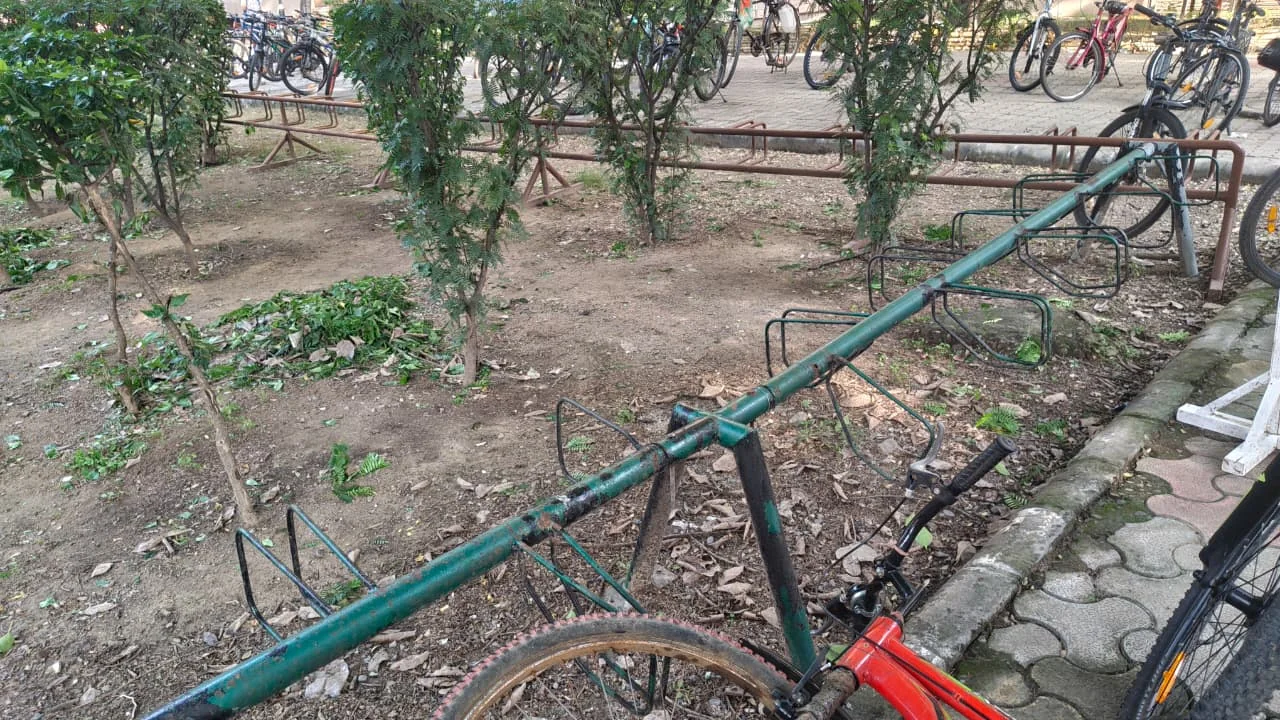
Several bars sit at a level change with no ramp or kerb cut. Reaching one means lifting the cycle, and some are set far enough back to read as part of the planted edge rather than the roadside.
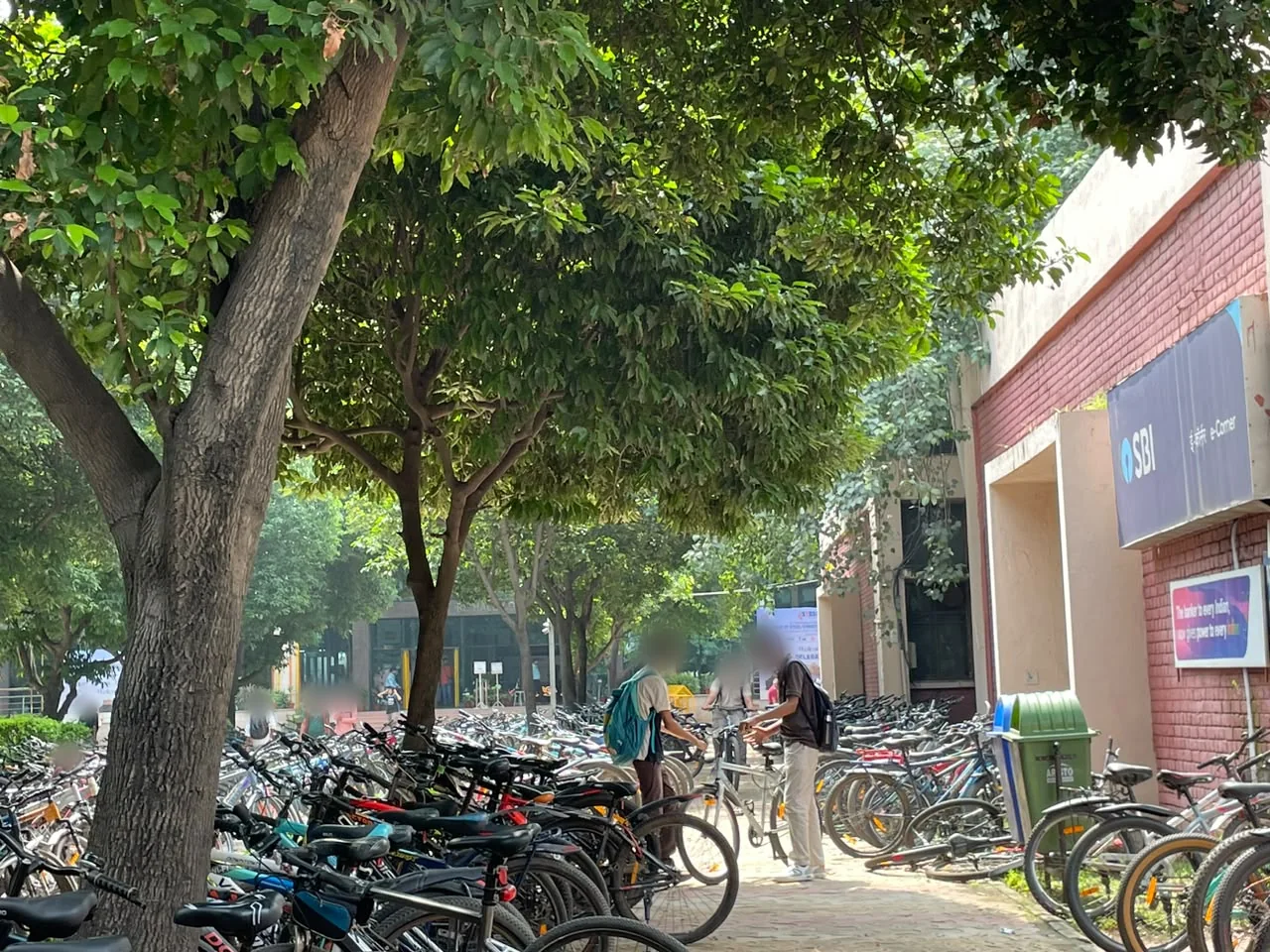
The bay near SBI stays close to ninety per cent empty for the same reason. Riders park on the adjoining footpath instead.
A marked no parking zone is in regular use. Riders asked about it had not registered that it was marked.
Social cues
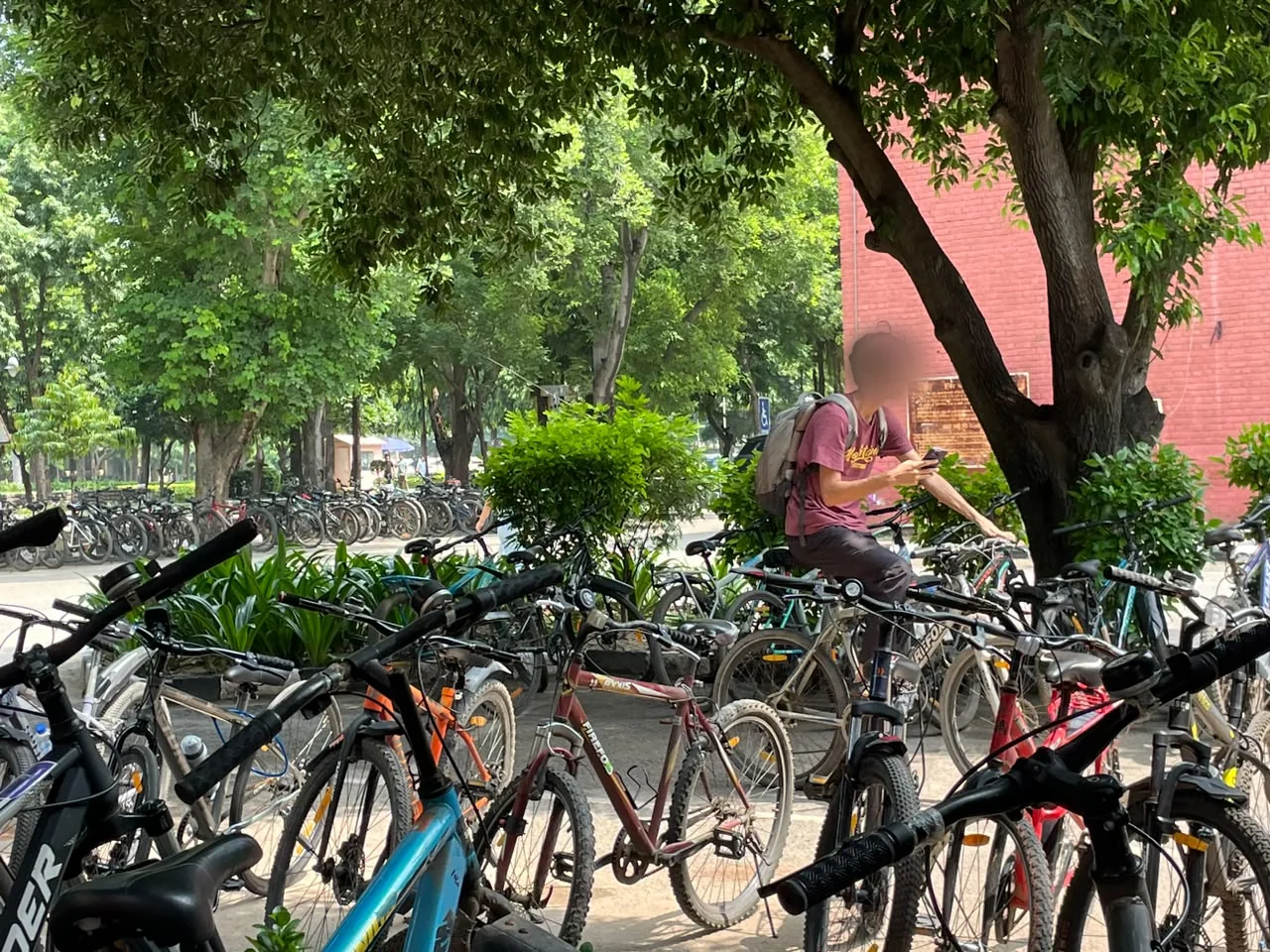
Riders park where cycles are already visible.
Clusters form nearest the lecture hall entrance. Riders wait for someone to leave, or pause and look, rather than use an empty bar a short distance away.
Some park near the SENSE building whatever the hour, citing safety, familiarity, and that friends park there.
Adaptations and enforcement
Parking on the footpath where the bay cannot be reached with the cycle.
Waiting or circling near the entrance rather than accepting a position further back.
Guards remove cycles left unlocked. One rider had a cycle taken and had to show proof of ownership to recover it. Checks appear to be occasional rather than systematic.
Jahan bikes parked dikhti hai, wahi kar dete hai.
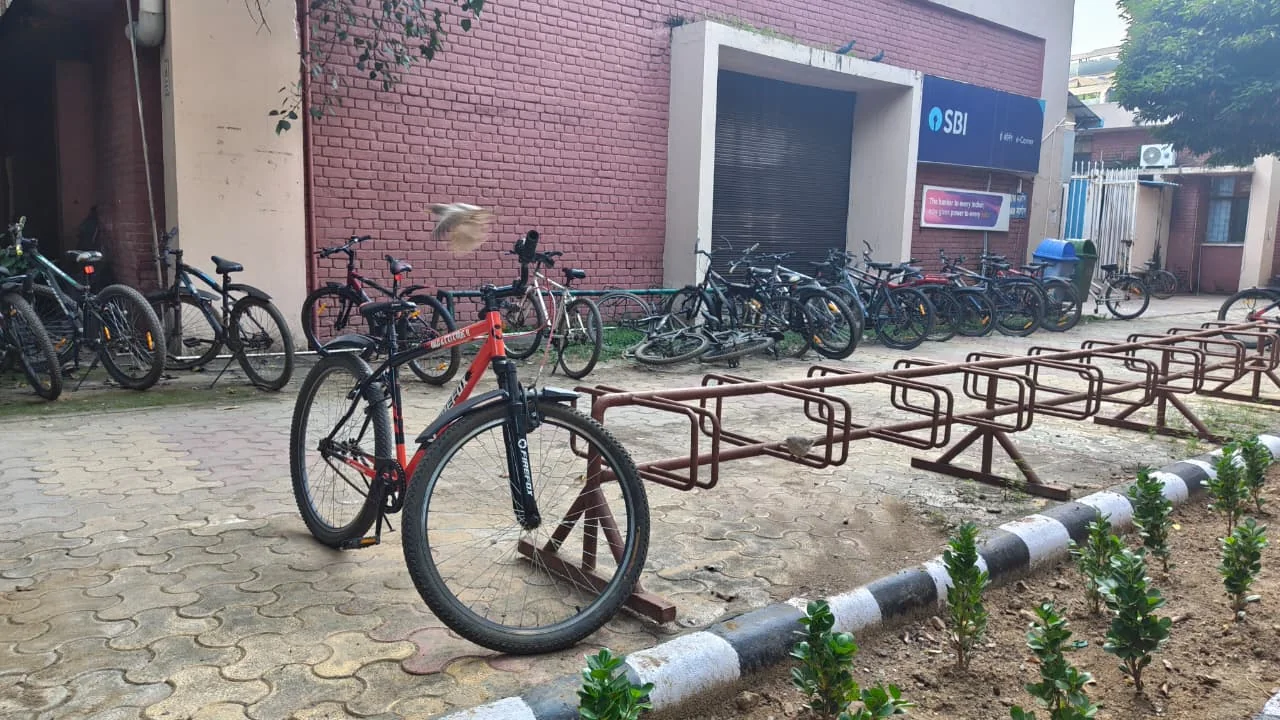
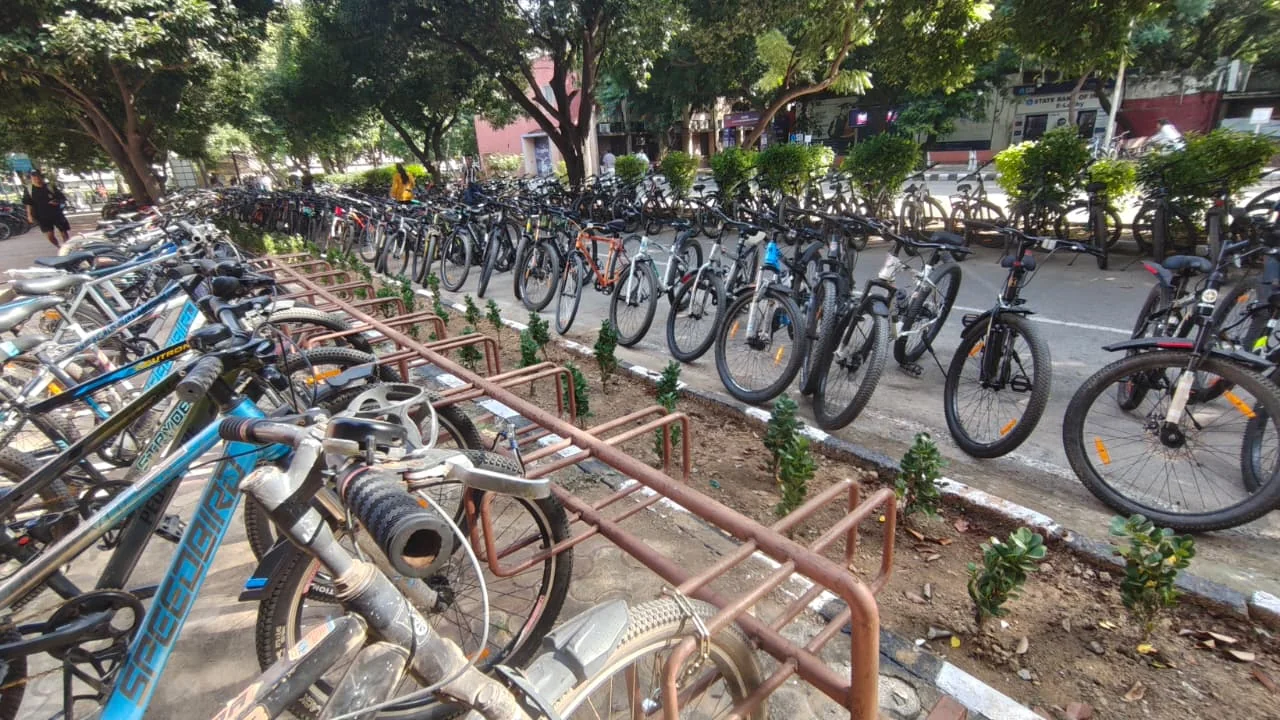
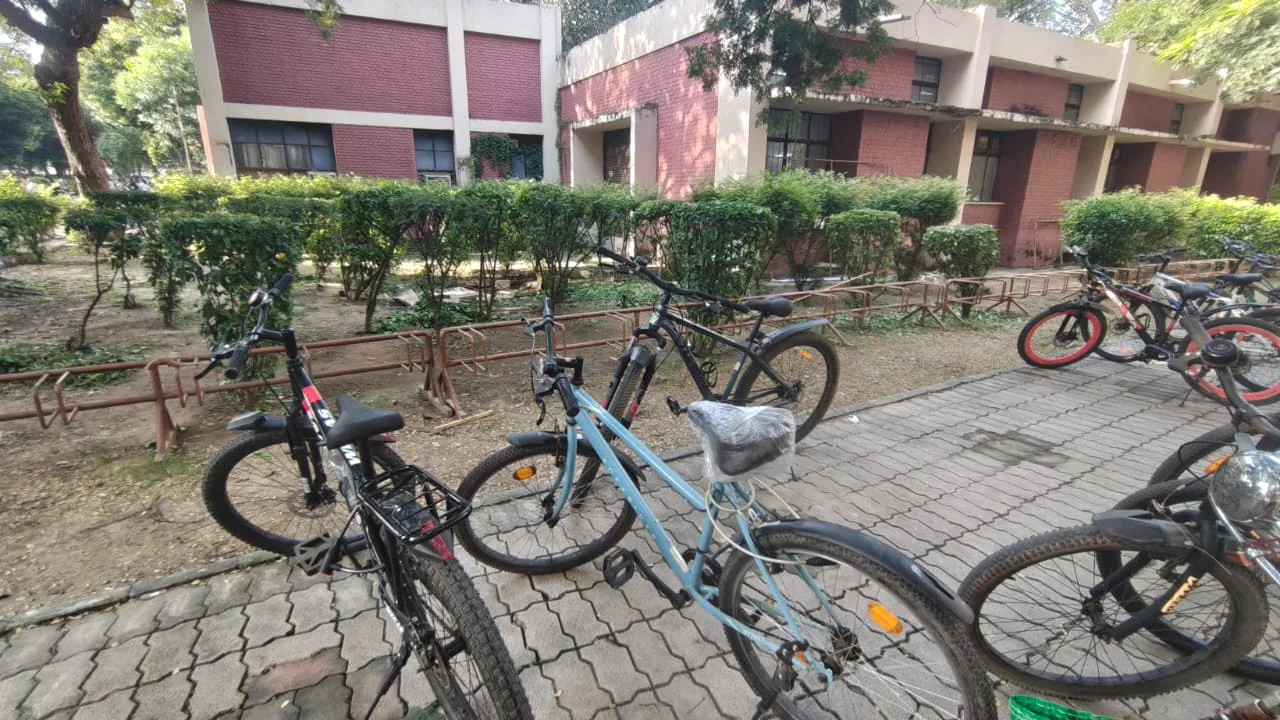
Provision is not absent. The bars exist and stand largely empty. What is absent is a usable route to them and any social signal that they are where a cycle is meant to go.
What was measured
Time
Duration, from the boundary start to the boundary end, is the primary measure.
Approach and search time runs from lane entry to committing to a position. Because the distance ridden varies, it is reported with approach speed, the distance ridden divided by that time, which separates travel from search.
Interresponse time is recorded in both windows, since entries cluster in each.
Response product
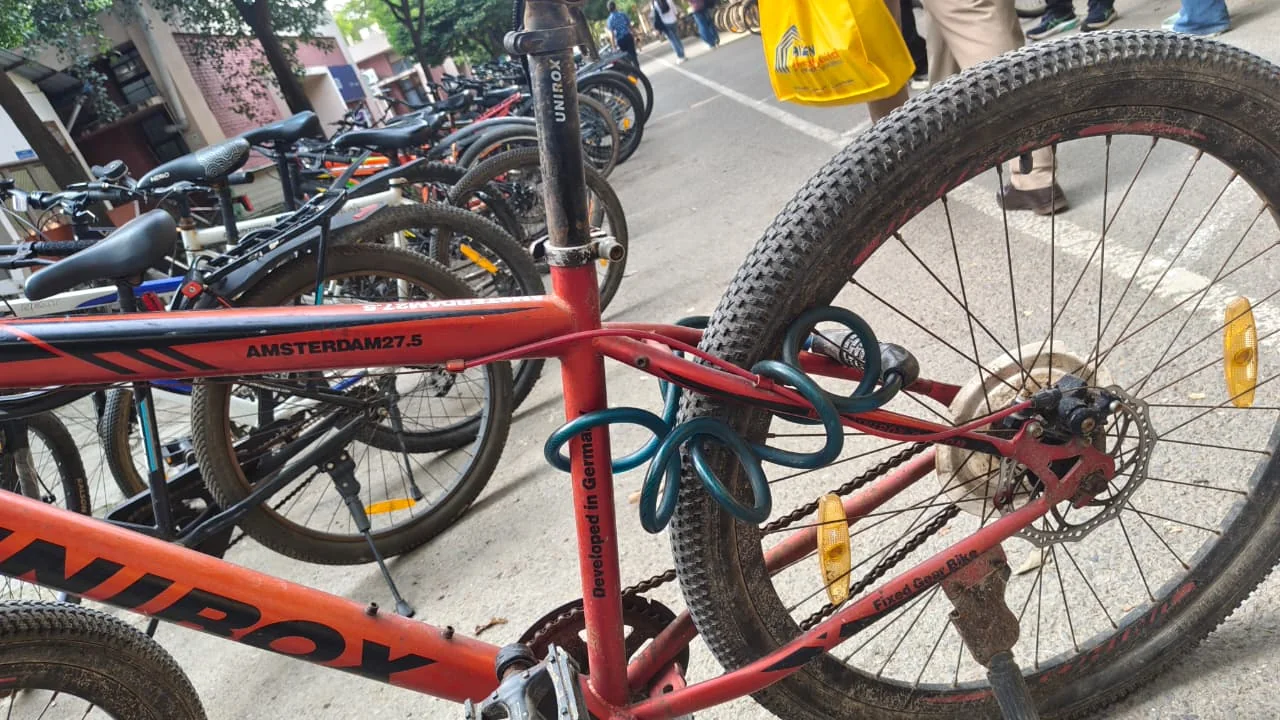
The parked cycle, coded by distance from the lecture hall end, side of the lane, means of support, locking configuration, and degree of encroachment into the through lane.
It is photographed after the rider has left, and recorded only for cycles parked during an observed episode, since a cycle already present cannot be attributed to an observed rider.
Group
Riders enter in pairs and small groups, and one person may hold a cycle while another secures it. As group behaviour it is collective, equivalent and interactive.
Cycles leaned on neighbours pass that dependency along the row, so one rider’s choice constrains the next. Each person is recorded as one instance and timed separately.
Fixed before the first session
- A group entering together is recorded as one instance per person, each timed separately.
- The observer remains at one position for the duration of a session, since observer movement affects the behaviour being recorded.
- Distance from the lecture hall end is read against the ten metre markers and recorded to the nearest metre.
- Faces are not photographed. The cycle is photographed after the rider has left.
The log holds 24 instances from window one and 22 from window two. One rider entered the lane and left without parking, and nine entries were made in groups.
Results
In every chart window one is drawn in black and window two in green, from 24 and 22 instances.
Median duration differed by under three seconds between the two windows
| Bin | Window one | Window two |
|---|---|---|
| 15 to 20 s | 0 | 1 |
| 20 to 25 s | 0 | 2 |
| 25 to 30 s | 3 | 5 |
| 30 to 35 s | 3 | 3 |
| 35 to 40 s | 7 | 5 |
| 40 to 45 s | 6 | 3 |
| 45 to 50 s | 4 | 1 |
| 50 to 55 s | 1 | 1 |
| 55 to 60 s | 0 | 0 |
| 60 to 65 s | 0 | 1 |
| Median, seconds | 37.5 | 34.9 |
Approach slowed from 2.44 to 1.54 metres per second once the near end was full
| Window | Occupancy, per cent | Approach speed, m/s |
|---|---|---|
| Window one | 24 | 2.29 |
| Window one | 28 | 2.49 |
| Window one | 30 | 2.95 |
| Window one | 31 | 2.67 |
| Window one | 41 | 2.49 |
| Window one | 42 | 2.49 |
| Window one | 44 | 2.51 |
| Window one | 47 | 3.13 |
| Window one | 48 | 2.48 |
| Window one | 48 | 2.62 |
| Window one | 52 | 3.17 |
| Window one | 53 | 3.02 |
| Window one | 58 | 2.33 |
| Window one | 59 | 2.16 |
| Window one | 62 | 1.83 |
| Window one | 65 | 2.24 |
| Window one | 68 | 2.21 |
| Window one | 72 | 2.38 |
| Window one | 73 | 2.04 |
| Window one | 75 | 2.45 |
| Window one | 76 | 1.71 |
| Window one | 78 | 1.71 |
| Window one | 83 | 2.43 |
| Window one | 84 | 1.73 |
| Window two | 92 | 1.5 |
| Window two | 92 | 1.56 |
| Window two | 92 | 1.73 |
| Window two | 92 | 1.9 |
| Window two | 92 | 2.09 |
| Window two | 95 | 1.36 |
| Window two | 95 | 1.44 |
| Window two | 95 | 1.48 |
| Window two | 95 | 1.58 |
| Window two | 96 | 1.54 |
| Window two | 96 | 1.71 |
| Window two | 96 | 1.91 |
| Window two | 98 | 1.32 |
| Window two | 98 | 1.39 |
| Window two | 98 | 1.48 |
| Window two | 100 | 1.0 |
| Window two | 100 | 1.3 |
| Window two | 100 | 1.3 |
| Window two | 100 | 1.54 |
| Window two | 100 | 1.88 |
| Window two | 100 | 1.89 |
| Window two | 100 | 1.93 |
Riders parked about twice as far from the lecture hall once the near end was full
Each stroke is one parked cycle, seen from above at its distance from the lecture hall end. The distances were grouped in ten metre bands, so within a band the cycles are spaced evenly. The median distance rose from 24 metres in window one to 50 in window two. The shaded band is the near twenty metres.
| Distance | Window one | Window two |
|---|---|---|
| 5 to 15 m | 8 | 0 |
| 15 to 25 m | 7 | 2 |
| 25 to 35 m | 8 | 3 |
| 35 to 45 m | 1 | 5 |
| 45 to 55 m | 0 | 8 |
| 55 to 65 m | 0 | 4 |
| Median, metres | 24 | 50 |
How the cycle was supported, and what the lock passed through
Means of support
| Support | Window one | Window two |
|---|---|---|
| In a bar | 2 | 1 |
| Own stand | 14 | 13 |
| Leaned on a neighbouring cycle | 6 | 3 |
| Leaned on a tree or pole | 2 | 4 |
| Laid on the ground | 0 | 1 |
What the lock passed through
| Configuration | Window one | Window two |
|---|---|---|
| Rear wheel only | 13 | 11 |
| Frame and rear wheel | 5 | 2 |
| Frame only | 4 | 6 |
| Frame and a fixed element | 1 | 0 |
| Not locked | 1 | 3 |
Most riders used the kickstand, and most locks held the rear wheel alone. One rider in 46 locked the frame to a fixed element.
Free bars lay within twenty metres in 39 of 46 instances and were used in 3
| Outcome | Window one | Window two |
|---|---|---|
| Parked in a bar | 2 | 1 |
| Free bar within 20 m not used | 18 | 18 |
| No free bar within 20 m | 4 | 3 |
Deviations from the two definitions
| Deviation | Window one | Window two |
|---|---|---|
| Encroaching on the through lane | 3 | 15 |
| Unstable on first placing | 6 | 9 |
| Left resting on a neighbouring cycle | 6 | 3 |
| Not secured at all | 1 | 3 |
| Parked in the marked no parking zone | 5 | 8 |
| Free bar within 20 m not used | 18 | 18 |
| Rear wheel immobilised only | 13 | 11 |
| Lock through the frame only | 4 | 6 |
| Engagement not verified | 14 | 15 |
Deviations are treated as findings rather than as recording errors. Each raises the question of what the lane afforded that made the deviation the lower effort option.
Analysis
Parking falls short on securing the cycle and on keeping the through lane clear
Action
- Whose actions
- Riders parking a cycle in the SBI Road lane before a class, mostly students. They are their own change targets.
- What actions
- Nineteen steps across four sub behaviours, from turning into the lane to stepping away toward the lecture hall.
- Where they start and end
- From the front wheel crossing into the lane at the northern end to the first step away toward the lecture hall.
- Excess or deficiency
- A deficiency of securing and a deficiency of clearance, rather than an excess of any action.
Time
- Is the action repeated within the window?
- Yes. Twenty or more entries within each twenty minute window.
- Does the time between actions matter?
- Yes, in both windows. Entries cluster, and riders queue behind one another where the lane narrows.
- Does the time taken matter?
- Yes for a rider who is late, and this is the most plausible explanation for a shortened securing sequence.
The lane gives a rider no sign of how much space remains ahead
Context
- Who is around them
- Other riders entering within the same minute, and pedestrians walking the through lane to the lecture hall. In the second window riders queued where the lane narrowed.
- Perception of what is happening
- Riders describe the lane as full rather than as unusable. Several were unaware that the zone they park in is marked no parking. Some cite safety, familiarity and where friends park as the reason for a fixed choice near the SENSE building.
- Psychological state
- Time constrained in both windows and more so in the second, where riders were observed riding the full lane before doubling back.
- How riders perceive and change the environment
- Each parked cycle removes kerb length and narrows the gap for the rider behind. A cycle leaned on a neighbour passes that dependency along the row, so one rider’s choice determines the options available to the next.
Targets
- Parts of the environment they interact with
- Road surface, kerb edge, gaps between parked cycles, adjacent cycles, the bars and the level change at their edge, tree guards and poles, kickstand, ring lock, cable, key, handlebar, basket and carrier.
- Modality of interaction
- Visual while scanning the rows during the approach and while judging stability. Manual throughout. Pedal at dismount and at the kickstand. Auditory at the click of the lock.
The lane provides no information about remaining capacity ahead of the rider. Bars are provided, but they are set away from the route and carry no signal that they are the intended place to park.
Parking near the lecture hall conflicts with keeping the through lane clear
Task model
- Goal and output
- Leave the cycle standing, secured and clear of the through lane, and proceed to the lecture hall. The output is a parked cycle at a particular distance from the building.
- Input
- What the rider can observe while riding in. The occupied length of each kerb, the width of visible gaps, whether cycles are already clustered ahead, the lock carried, and whether a bar, tree guard or railing is reachable from the kerb.
- Process
- A single pass down the lane with a continuous choice of where to stop. Four means of support and five locking configurations. A rider who overshoots must double back.
- Presentation
- Bars are provided, but several sit at a level change with no ramp or kerb cut and some read as part of the planted edge. Nothing indicates remaining capacity ahead, and the marked no parking zone goes unregistered by riders who use it.
- Time
- Concurrent with the journey. The approach and search component is the largest part of the duration in both windows.
Where complexity arises
- Clarity
- Goal clarity is high. Input clarity is low, since capacity further down the lane is not visible from the entry, which is what produces the overshoot and doubling back.
- Quantity
- A continuous rather than discrete set of positions, four means of support and five locking configurations. The absence of any signal about which are acceptable removes the benefit of that redundancy.
- Conflict
- Parking near the lecture hall conflicts with keeping the through lane clear. Securing to the topographical definition conflicts with the time constraint and, further back, with the absence of anything to secure to.
Limits of the comparison
Observer presence and paced distances limit how precisely the two windows can be compared.
- Being seen
- Riders who noticed the observer slowed or looked across. The fixed position reduced this, although the first few instances of each session are unlikely to be comparable with the remainder.
- The start point
- A rider who dismounts before reaching the lane entry makes the start ambiguous. The rule adopted was that the wheel crossing into the lane governs, whether or not the rider is still mounted.
- Counting groups
- Recording one instance per group and recording one per person produce different results. The convention was fixed in advance and applied consistently across both sessions.
- Authorship
- A cycle already in the lane cannot be attributed to an observed rider, so the response product could only be recorded for observed episodes. This cut the usable product data below the instance count.
- Distance and speed
- Distance was read against markers paced out beforehand rather than measured, so distances are accurate to roughly a metre and the derived approach speed inherits that error.
Riders seem to bypass the bars because reaching one takes a lift and nothing marks them
Three things keep riders away from the bars. Several sit at a level change with no ramp or kerb cut, so reaching one costs a lift rather than a wheel. Nothing marks them as the intended place to park, and the marked no parking zone that riders do use goes unnoticed. Riders take their cue from where cycles are already visible, which holds them to the clusters nearest the entrance.
Enforcement acts on a different step. Guards remove cycles left unlocked, which bears on locking, while where the cycle is placed is left entirely to the rider.